Category Archives: Books

Planner, Pantser, Pouncer

At a recent gathering of writing friends, the topic of planner vs pantser came up.

I declared that I used to call myself a pantser (a person who writes by the seat of their pants according to the whims of the day), but I learned that I needed to add in a little more planner (a person who plots out stories in advance) to get things done.

Cover of Story Genius: How to Use Brain Science to Go Beyond Outlining and Write a Riveting Novel (Before You Waste Three Years Writing 327 Pages That Go Nowhere) by Lisa Cron

For more on this, I recommend Story Genius: How to Use Brain Science to Go Beyond Outlining and Write a Riveting Novel (Before You Waste Three Years Writing 327 Pages That Go Nowhere) by Lisa Cron.

One man in the group had never heard these expressions. He asked for clarification. “Did you just say planner vs pouncer? Because that’s what I do. A thought occurs to me and I pounce on it.”

How wonderful! He added a third element to the conversation, one that both planners and pantsers can embrace.

For example, careful planners who are stuck at a story plot point might take a walk for inspiration. While strolling their eyes might fall on something that triggers the solution to their next step. Ah ha! They would cry as they pounce on the idea, hurry home and add into their overall plan.

Freewheeling pantsers might sit with fingers on keys or pen hovering over paper. Open to receiving as they are, a thought—the genesis of an idea—arrives to them from the Amazing Mystical Universal Supply of Ideas and they pounce.

Are you a planner or a pantser? Even if you’re not a writer, have you pounced on any good ideas lately?
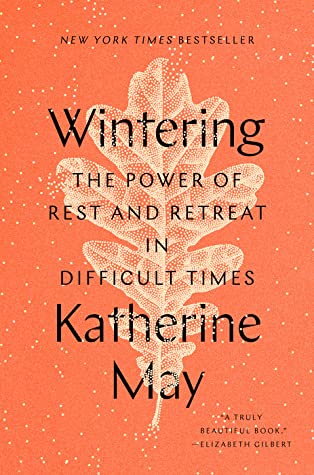
Photo by Flickr on Pexels.com

Being rid of that which does not feed us

I have been reading Wintering: The Power of Rest and Retreat in Difficult Times by Katherine May, a recommendation of TheHomePlaceWeb blog.

The book provides solace to the soul, and that is something we citizens of Ottawa, Canada need in our difficult times.

Katherine May writes about how we think of life as linear, a slow march from birth to death. That is true, but May reminds us that the pattern of life is also cyclical, or seasonal. We circle through periods of beginnings and endings, storing up and shedding, and wakefulness and sleeping throughout our lives.

At the beginning of a day, or a project, or a course of study, we are similar to trees with green leaves full of chlorophyll. The leaves absorb sunlight and convert carbon dioxide and water into tree food, and we absorb information and convert physical supplies into some sort of product that serves to advance our lives. Spring and summer cycles are about gathering and growing.

At the end of a day, or fiscal year, or a career, we prepare for change in the way of a tree. The chlorophyll in leaves breaks down in fall. The green disappears and exposes other beautiful colours that were always there but hidden. In a process called abscission, the cells between the stem and the branch weaken until supply to the leaf is cut off and the leaf falls. In our lives, this is when we pass on clothes we no longer need, or clear out university textbooks, or pack up personal belongings from the office and walk out the door.

Abscission, the process required for shedding of leaves, is “part of an arc of growth, maturity, and renewal.” In other words, to protect ourselves and stay strong, sometimes we need to rid ourselves of that which no longer feeds us.

BUT—and this is important —even on the coldest, darkest days of winter, when deciduous trees appear fully dead, there are buds. They are small and protected by thick scales, but they are there.

“We rarely notice them because we think we’re seeing the skeleton of the tree, a dead thing until the sun returns. But look closely, and every single tree is in bud . . .”

From Wintering: The Power of Rest and Retreat in Difficult Times by Katherine May
A twig of a deciduous tree in February against a background of snow. The branch has buds protected by thick scales.
Buds waiting for the sun

On this cold winter day in Ottawa, it helps me to know that buds are in place. It allows me to believe that the events taking place in downtown Ottawa had a spring, summer, and fall season and that the time of shedding approaches.

Soon we will be rid of that which does not feed us.

Nonplussed: Can’t trust that word

While reading Denial by Beverley McLachlin this week, I came upon the word nonplussed.

Nonplussed is one of those words that people don’t use in conversation. We are left to conclude its meaning from where we find it in writing. Up to this week, every time I’d read the word it had meant unperturbed.

In her book, McLachlin used the word in a way that did not mean unperturbed. Quite the opposite. Her character was taken aback and surprised by his circumstance.

Seeing this, I was taken aback and surprised. Nonplussed, as it turns out.

I said to my husband, “What do you think nonplussed means?”

“Surprised,” he said.

Huh. I touched my finger to the word in my e-book and selected “Look up.” The answer came:

1: unsure about what to say, think, or do:  Surprised
2: not bothered, surprised, or impressed by something: Unperturbed

I am not nonplussed (unperturbed) by these definitions. I am quite nonplussed (surprised).

What to do with a word with two opposite meanings?

May our politicians never make use of the term. Misunderstanding and world conflict could result.

No, no, nonplussed is a word not to trust.

Galore: A reflection on where I’m from

galore (adv.)
1670s, from Irish go leór, and equivalent Scottish Gaelic gu leóir “sufficiently, enough,” from Old Irish roar “enough,” from Proto-Celtic *ro-wero- “sufficiency.”

https://www.etymonline.com/word/galore

My father was adopted.

He was raised with love by a family with Irish roots. My entire life I associated strongly with that Irish heritage. I sang and danced during the loud and proud St. Patrick’s Day celebrations in Canada’s Ottawa Valley.

Then, this past Christmas, my son gave me a DNA test as a gift. The results showed my Irish DNA at the BOTTOM of the list of the ethnicity estimate, at 2 %.

2 %. I couldn’t have been more astonished.

A second surprise lay in store. The largest percentage of my DNA indicated Scottish and Scandinavian heritage. I am three-quarters Scottish and . . . Viking, I guess?

In September, as fate would have it, my son headed off to Edinburgh, Scotland to do his Master of Physiotherapy. We won’t travel there just yet (you know . . . COVID), but we’re making plans for future trips. I began to read Love of Country: A Journey through the Hebrides by Madeline Bunting.

I read about the land of my DNA. I read of crofts (small rented farms with a right of pasturage held in common with others), and machair (fertile plains), and lochan (small inland lakes). I learned the roots of the word galore (see above) and mused about how wonderful it is that galore really means that you have everything you need for the given moment.

All of this got me to thinking about where I’m from (Scotland/Scandinavia) as opposed to where I am really from (the Ottawa Valley, Canada).

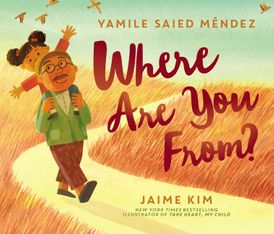
This past week, the book Where Are You From by Yamile Saied Méndez passed through my hands at the library where I work. It is the story of a child who must answer where she is from—no, where she is really from—to the point where it hurts.

When people ask someone like me where I’m really from, it means Where were you raised? What is the place that formed you?

For racialized people, the situation is reversed. For them, where are you really from means What foreign country did your people come from?

That makes it a backwards question, because for any of us, the place where we are really from is the place that has formed us.

My DNA says that the foreign countries my people came from were Scotland and the Scandinavian countries, but I’m really from a farm in the Ottawa Valley. I’m really from a place where we dug in the dirt to grow our food, where we wore hand-me-downs, and where neighbours and families helped each other out. On any given day we had everything we needed. Sufficiently, enough.

In other words, we had plenty galore. What a fine place to be from. Really.

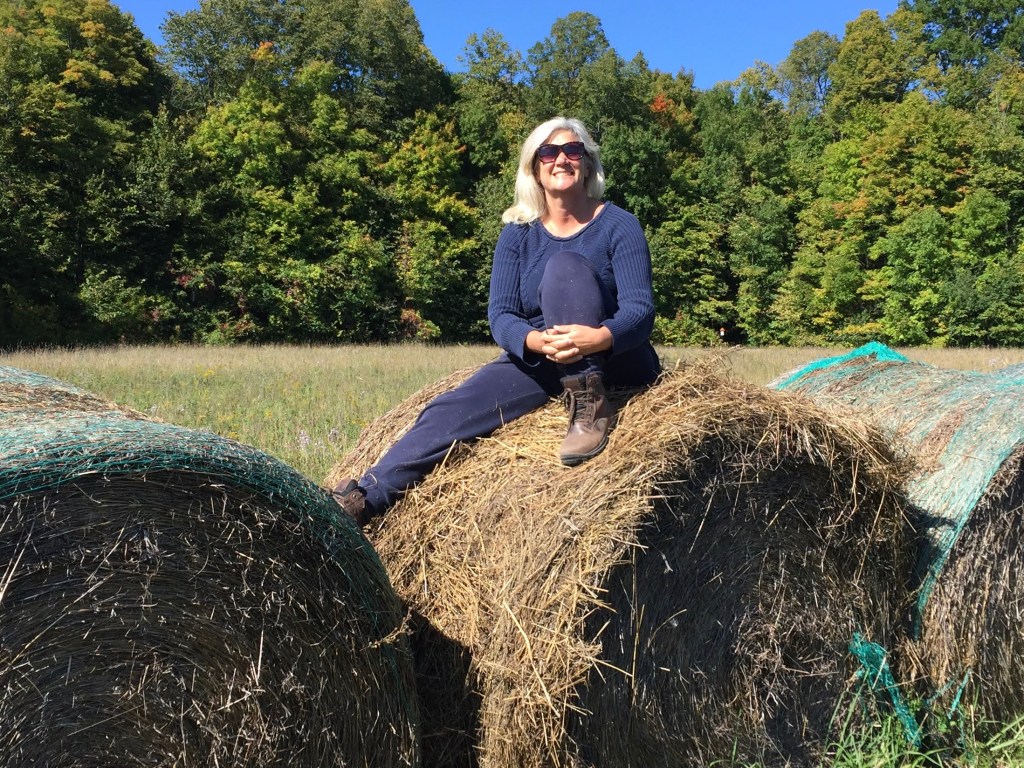
Arlene sitting on a round hay bale in a farm field.

Mind like water: Stress-free productivity

Don’t get set into one form: adapt it and build your own, and let it grow. Be like water. Empty your mind. Be formless, shapeless—like water. Now you put water in a cup, it becomes the cup; you put water into a bottle it becomes the bottle; you put it in a teapot it becomes the teapot. Now water can flow or it can crash. Be water, my friend.

—Bruce Lee as found in Getting Things Done: The Art of Stress-Free Productivity by David Allen

Over the past year, during my work at the library or as a writer, I’ve heard comments like this:

  • I’m trying to read now that I have more time, but I can’t concentrate!
  • My mind doesn’t want to focus on anything “heavy.” My productivity has plummeted.
  • I’m supposed to be working/writing, but it’s so difficult to stick with it.

The stresses of COVID are messing with our minds, and our productivity.

Today I wanted to lie on my couch and do nothing. That sounded like the BEST plan.

I opened my phone. I clicked on an old link. I found Bruce Lee’s phrase, and I got up off the couch.

“Imagine throwing a pebble into a still pond. How does the water respond? The answer is, totally appropriately to the force and mass of the input, then it returns to calm. It doesn’t overreact or underreact.”

David Allen in Getting Things Done: The Art of Stress-Free Productivity

If I throw a rock into a pond, the water has to react. It can’t NOT react.

COVID threw a rock into us. It was a BIG rock. We responded. We couldn’t NOT react. And we reacted appropriately to the force and mass.

Now, like water, we can return to calm. Out of that, productivity flows.

Ripples on water

Squirrels with no fur upon thars

This post from my previous site is another one that continues to gather regular traffic.

Way back in 2012, I was standing at my kitchen sink washing dishes when I saw something that made me stop in the middle of scrubbing a pot: a creature in my back yard looked suspiciously like a rat. Yikes.

I watched it for a while wondering how much rat traps cost. Then I realized that it looked like a rat, but it didn’t behave like a rat. It behaved exactly like the other squirrels frolicking around my yard.

It was a squirrel with no fur on its tail.

The next day a second squirrel with no fur on its tail appeared; this one was grey. What was going on? How could there be two squirrels of different colours with furless tails?

Grey squirrel with no fur on its tail
With apologies for the blurry photos. This was 2012, after all.

I have since learned that they probably had mange, but at the time I didn’t know that.

What made my heart glad was that all the squirrels, whether they had fluffy tails or not, played together happily.

It reminded me of  “The Sneetches” by Dr. Seuss.

In that fabulous story, some Sneetches have stars on their bellies, but Plain-Belly Sneetches had “no stars upon thars.” In the beginning, the Star-Belly Sneetches won’t associate with their plainer counterparts. By the end of the story, after Sylvester McMonkey McBean sends them all on several trips through his Star-on or Star-off machine (only ten dollars each) the Sneetches no longer know “Whether this one was that one . . . or that one was this one / Or which one was what one . . . or what one was who.”

In other words, the Sneetches discovered that it’s what’s inside that counts. That’s something my backyard squirrels seem to know instinctively. They play together whether or not there is “fur upon thars.”

The Sneetches learned, the squirrels know it. Can we figure it out?