We have a lawn at our cottage, but it’s not a flawless stretch of green grass. The rural property at this time of year is dotted with daisies, which we resolutely mow around.
The tradition began with my mother-in-law. She wanted to keep the lawn looking nice and well cared for, but she couldn’t bring herself to mow down a beautiful flower in a natural setting. We honour her when we leave those daisies swaying in the summer breezes.
I’m not sure what our neighbours think of the patchy mowing job. Perhaps they mutter: “I wish those people would do something about that lawn.”
My wish would be that they choose instead to enjoy the beautiful flowers and take a moment to feel grateful for the gift from nature.
I don’t know about you, but during this pandemic I have read more books electronically than ever. Without book stores or libraries, I have turned to e-books for my fix.
I prefer a paper book, but needs-must. The one thing I do like better about an e-book is the built-in dictionary. If I don’t know a word, I touch my finger and, voilà, there is the definition.
Here are some words I have learned in the past few months, used in a sentence:
glabellar: The smooth part of the forehead above and between the eyebrows. (Now that I’m older, my glabellar is not as smooth as this definition implies.)
synesthesia: A neurological condition in which information meant to stimulate one of your senses stimulates several of your senses. (Some people with synesthesia always see the letter A in the colour red, and when I see I word I don’t know in a book, I see red.)
faffing: [UK informal] To spend time doing a lot of things that are not important instead of the one thing you should be doing. (At a cottage it is easy to spend time faffing around instead of writing blog posts.)
hierophant: A person, especially a priest in ancient Greece, who interprets sacred mysteries or esoteric principles. (I need a hierophant to help me understand some things in the books I’m reading.)
tricoteuse: A woman who sits and knits, a reference to women who did this at public executions during the French Revolution. (I would be willing to become a tricoteuse during the trial of a writer who uses the word tricoteuse.)
prelapsarian: Characteristic of the time before the fall of man [Editor’s note: they mean people], that is, innocent and unspoiled. (In the prelapsarian Eden, people used non-gender specific language.)
hoaching: Full of or swarming with people. (During this time of pandemic avoid hoaching places.)
How are you reading these days? What have you learned from that experience?
At a cottage it’s easy to spend time faffing around.
suck away hours of time for a project you’re not passionate about
lead you to grand adventure, in the way of Shonda Rhimes
Saying no can
save you from being used or abused, or from drugs as Nancy Reagan would have wished
deny you fun or a fantastic learning and growing experience
Some days, on the surface, it seems hard to decide. You have to dig deep before the answer is clear. When you do, you discover you just . . . know.
Other times the answer is spelled out.
In my cottage area, garbage must be protected from wild animals. Waste management workers need to access the containers, so parking in front of them is a definite NO.
I love the simplicity of the sign. One word. No explanation required. If you’re the person thinking of parking in that space, just . . . no.
You just know, or just no. The answer is always clear.
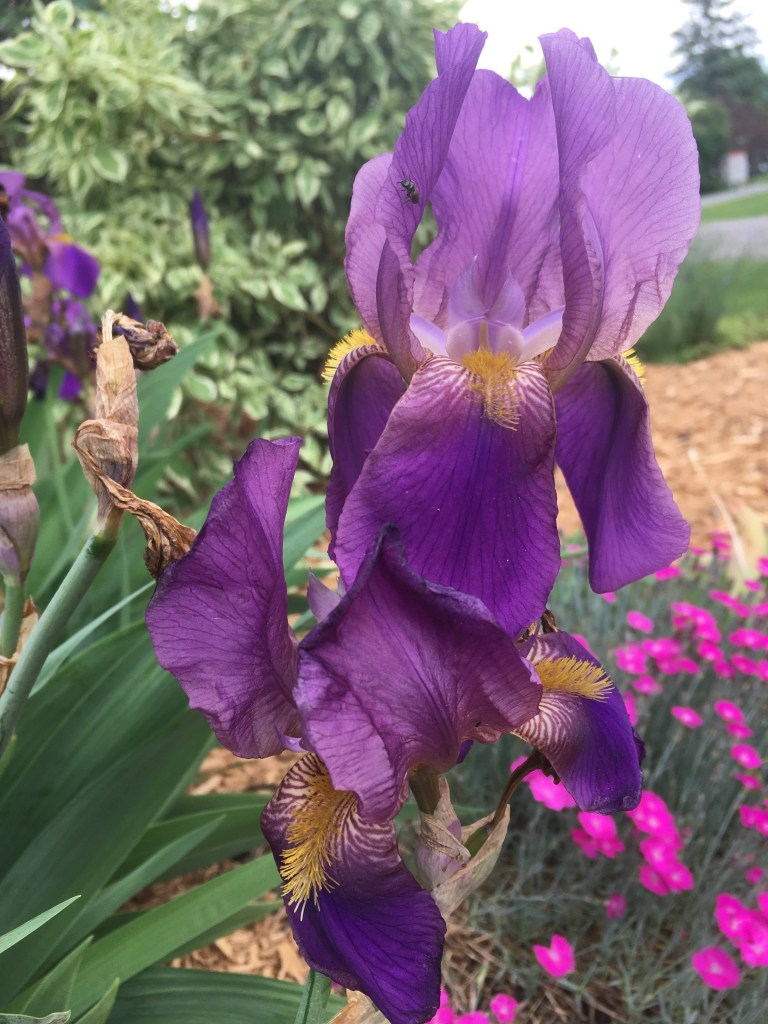
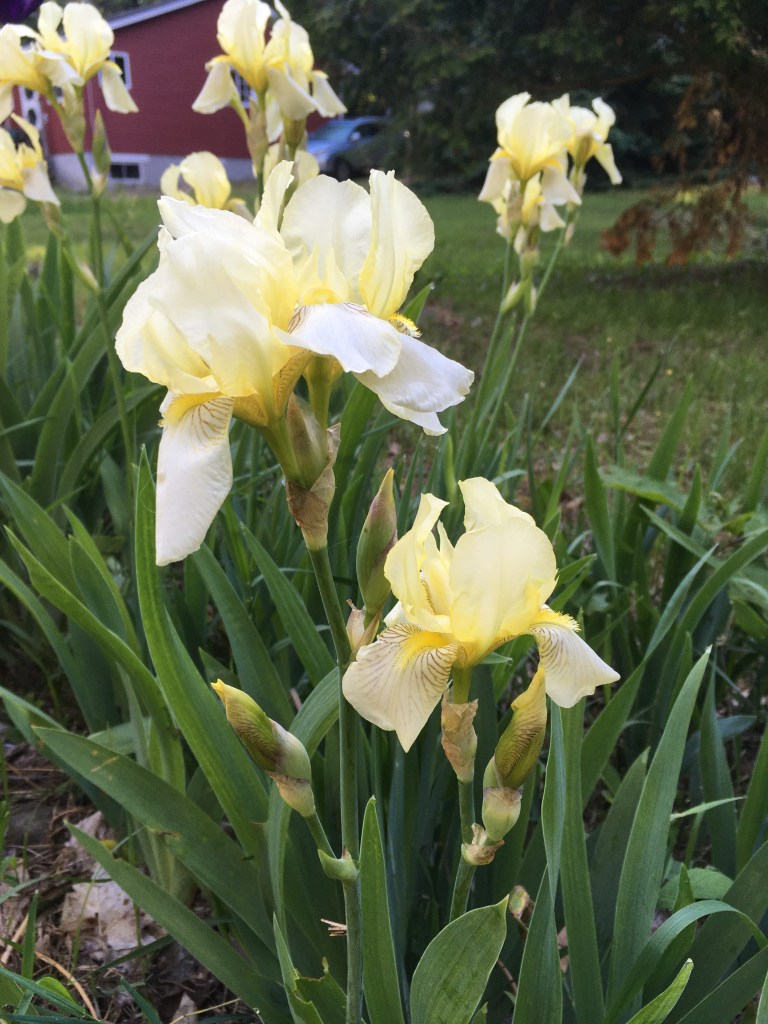
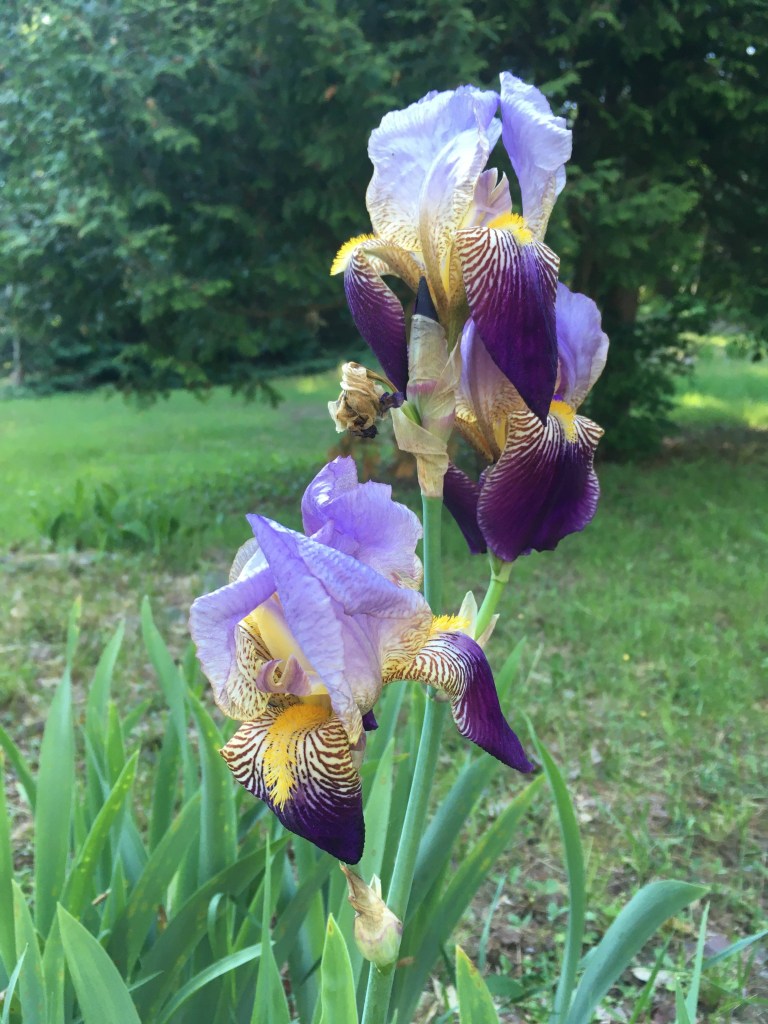
Neighbours passed my house when the irises were in their full glory.
“Your irises are lovely,” one said. “Too bad they don’t last longer.”
“Well, I guess they’re here for when they’re supposed to be,” I said. “After the spring flowers and before everything else.”
Early spring snowdrops were long gone, and my tulips and daffodils had already lost their heads. But the alliums had not yet burst out in their fireworks shape, and the poppies, bee balm and clematis were still forming buds.
The irises, between all of that, waved their purple heads at passers by.
It’s not the irises job to carry the load of my garden beauty for the whole summer. They perform spectacularly right where they are planted, at exactly the right time, and they enjoy everyone’s full attention.
“. . . when you get the choice to sit it out or dance | I hope you dance . . .”
From “I Hope You Dance,” written by Mark D. Sanders and Tia Sillers, performed by Lee Ann Womack
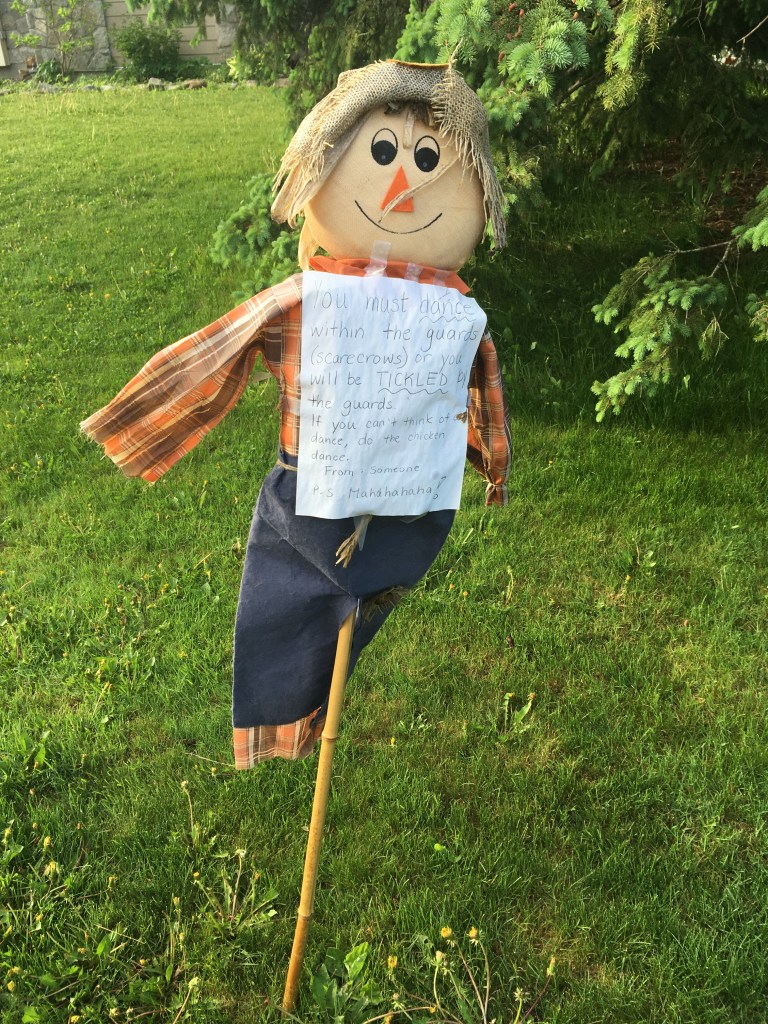
Some neighbourhood kids came up with a fun activity. They posted two scarecrows on their lawn with a sign:
“You must dance within the guards (scarecrows) or you will be TICKLED by the guards. If you can’t think of a dance, do the chicken dance. From someone. Ha ha ha ha ha!”
My son and his girlfriend stopped during their walk and danced.
My husband and I danced.
I have to admit that I didn’t dance every time I passed the sign. I go by it every day on my walk, twice.





 Somerton Smith