said-bookism (plural said-bookisms) – Noun
1. The studious avoidance, in writing dialogue, of the word “said”.
Synonym: bookism
https://en.wiktionary.org/wiki/said-bookism
Experts said: Don’t drown your dialogue in attributions like exclaimed, whispered, demanded, asserted, murmured, shouted, whimpered, inquired, queried or, heaven forbid, spat. [The experts pleaded, prompted, advised, demanded, urged . . .]
I agreed with that advice.
But then, I began a clutter clean-up in my basement, and I happened upon a notebook from my Grade 8 English class. On the last page, I found this: a list of words to use instead of said. Way back in the 1970s my teacher advised me to liven up the story. Avoid using said, they said (proposed, urged argued . . ..
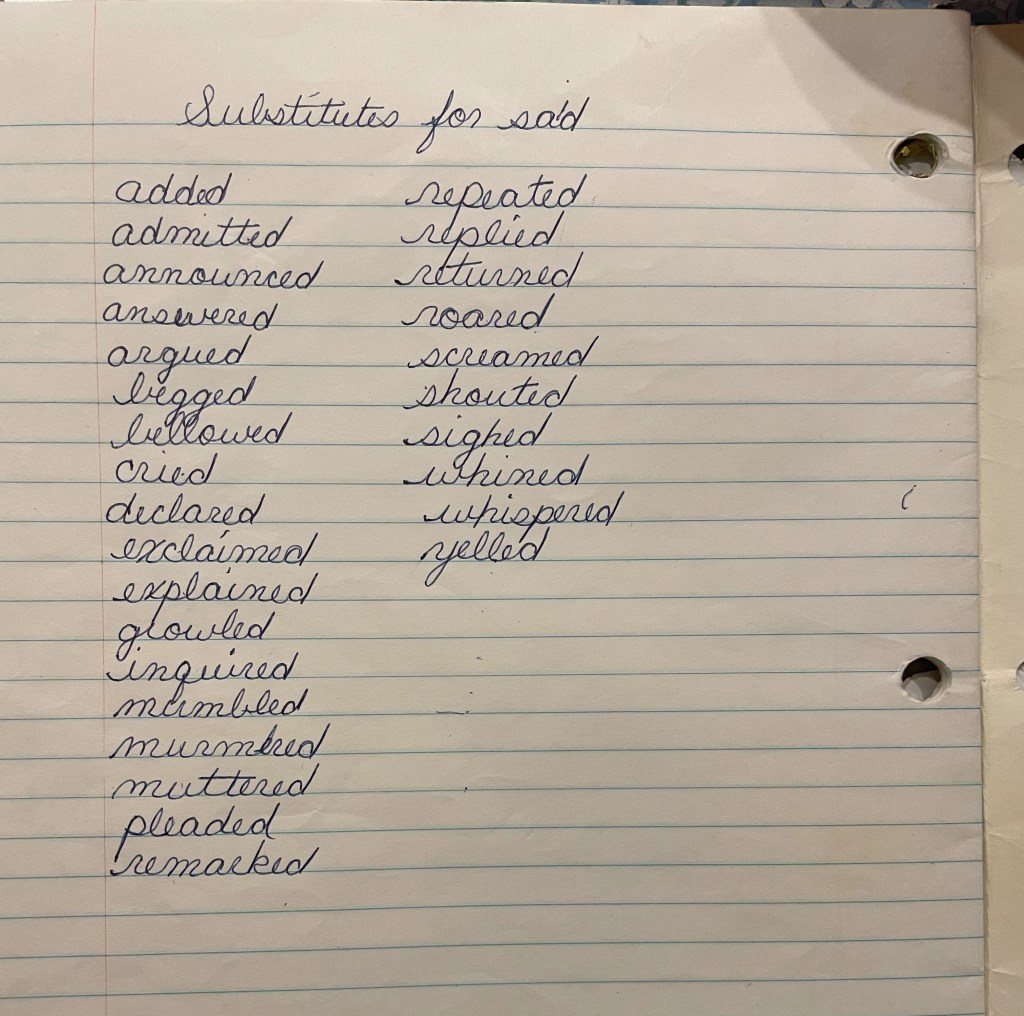
The pendulum swung toward repeated, roared, whined, yelled, remarked, declared, bellowed, argued, announced . . .
Good heavens, but that became tiresome, if not outright ridiculous. So the pendulum swung back to said.
And now, the pendulum swings again. As readers we find we don’t mind an occasional declaration. If a character roars now and then, it’s okay!
What do you think? Do you enjoy writing enlivened by interesting attributions, or do you prefer our good old standby said?
 Somerton Smith
It’s okay to use said once in a while, but I consciously choose more expressive words when I can.
“By the way, your 8th grade penmanship is beautiful,” she said.
Interesting! I use said almost always. It is a word that lets the dialogue speak for itself, I find.
Thank you for noticing the penmanship. I was impressed with it myself. You should see my handwriting now. Indecipherable at best, most days. I think I need to start slowing down and taking more care, the way I did back the Grade 8.
Agreed, especially on the penmanship. I wonder if the best “test” for the right amount of usage of said is that someone who’s reading your work doesn’t notice it?
One rule I do tend to agree with is the “very”—the less of that we use, the (very :P) better? 🙂
I agree – if the reader doesn’t notice the dialogue tags you’re using, you’re doing something right.
“Very” is a very (Ha!) good word to get rid of most of the time.
Hey you’re back to blogging, she exclaimed. Although I might have said it. My point is I’m glad to see you blogging and that I like both ways of phrasing things.
Haha, yes, I’m back, just as you’re taking a little break, I think?
I belong to a writing group, and we chose to set goals together. One of my goals was to get back to blogging. Last fall I changed work hours, and for a period of time I was working Mondays for the first time in many years. I always used to do my blogging “thinking and drafting” on Mondays. I thought I could do it on another day instead, but that didn’t happen. Now my work hours have changed again. Mondays are mine once more! (She exclaimed.) So here I am – thrilled to see your name on my comments.
A necessary reminder that preferences in writing styles is ever-changing, evolving and revolving.
“More show, shorter books,” they said.
“When the pendulum swings again, we will revisit longer passages of descriptive detail and longer books,” they counter.
Yes, I agree. Pretty soon they are going to be telling us that our books need more adverbs . . .
I think it is occasionally acceptable to use something other than he/she said. I think asked, for example is obvious…I don’t want to do that often, I prefer in a long dialogue to drop the attribution as long as it is clear who is speaking.
I think pendulums swing a lot — that is what they do! I like it when they don’t swing too far on either side. Many authors I read now have dropped so many conventions I was taught were absolutes.
You’re right – dropping the attribution altogether is a good idea too. I doubt that writers will every agree on everything. It’s an ever-evolving process. I see a lot of comments these days about the Oxford comma, for example. People get very worked up about that! Thanks for visiting my site and commenting.