When I was in university years ago, I applied for a job. During my interview for the position, the board asked me to place the following items in order of importance: family, sports, friends, work, homework.
All these years later I now understand that the intent behind the question was: On any given day, when nothing special is going on, will you show up for work even if you have an overdue assignment or your friends are hosting the funnest party ever?
They wanted the answer to be: work, homework, family, friends, sports.
At the time I was thinking BIG PICTURE. What is most important, really? What is most important during times of crisis? What amounts to more than what you can carry in a file box at the end of the day?
I answered: Family, friends, work, homework, sports.
Ididn’t get the job, but I still think I gave the right answer.
I was reminded of this by a video a friend posted on Facebook. It is important to take care of the big rocks first, or your life will be nothing but dust and pebbles.
Who are the people helping you through this pandemic? I have neighbours, friends, my book club, and writing circles. I also have a core group of people who support me in all things: the fellow members of my progressive faith community, tirelessly doing good in the world. Here are my top 10 reasons why they are my peeps.
10. Critical thinking
There are faith communities out there that don’t tell you what to think. (There are. Really.) There are faith communities that say, “Yeah, I don’t know what it’s all about either, but let’s explore this mystery together.” Churches, mosques, synagogues and temples provide places for you to sit and listen and ponder fundamental matters.
9. A community of support
When life brings you to your knees (and it will) a faith community helps you through. The connections forged at deep levels in these groups help people to rebuild lives after tragic events like the loss of a child, the early death of a spouse, or global pandemic.
8. Lifelong learning
“I am still learning,” Michelangelo said. An insatiable curiosity drives happiness, and faith communities come with an endless supply of brain teasers.
7. Singing!
Our popular culture provides so few opportunities for belting out a tune. If you want to sing, play the guitar, or bang a drum, we have the place for you. Best of all, when you sing in these venues, even a solo, you don’t have to be perfect. The audiences are very forgiving.
6. Child education
What does the wisdom of Solomon mean? Under what circumstances might one require the patience of Job? What is a David and Goliath situation? How many prodigal sons, or daughters, do you know? Have you ever been the Good Samaritan? Our societies, our art, and our literature contain religious references which would be meaningless without adequate education about our heritages.
5. Ritual
Humans create rituals. It is what we do. Jumping into, or out of, any particular activity without some form of ritual feels wrong. At a hockey game we introduce the players and sing the national anthem. At graduation ceremonies we wear gowns, deliver moving speeches, give individual rewards, and have a group celebration. Faith communities provide grounding rituals for the most pivotal moments in our lives. Sometimes the comfort of ritual is all that gets someone through the night.
4. Peace
When I returned to church as an atheist adult, I did it for my daughter. I was shocked to discover there was something for me too. At the time I had a young baby, I worked full time and we had just moved to a new house. I was stressed. When I went to church each week, I left my baby in the care of the nursery workers and sat in the pew. I expected to sit and roll my eyes at everything the minister said. Instead each week he said something that made me think. Each week he said things that surprised me, challenged me. Each week, at some point, I had tears in my eyes. That hour of peace fulfilled a need I didn’t even know I had.
3. Helping others
Faith communities pick up where social agencies drop off. The charitable donations and volunteer activities of members of all kinds of faith communities keep many aspects of our society afloat. Clothing donations, homework programs, soup kitchens, food banks, emergency assistance, global outreach. The charitable deeds amount to millions of volunteer hours and billions of dollars.
2. Creativity and growth
A former minister of mine used to say, “Do it, and you’ll grow.” This simple statement encouraged many to take on tasks that made their fingertips tingle with fear. Our involvement with faith communities pushes us to do work that stretches us past our comfort zone. Every time we climb over our fear and break through that barrier, we grow. We learn to get past fear. Are you brave enough to deliver a Christmas basket to a family in need and share the experience in their home? Would you teach Sunday School? Preach a sermon? Do it, and you’ll grow.
And the number 1 reason to belong to a faith community . . .
1. Fun
So many of the activities in faith communities are just plain fun!
I am re-posting this piece from the past, because it is one of my favourites.
My eye falls upon a Frisbee—upside-down, silent, waiting—on the family room floor where my son dropped it.
I contemplate the restful disc. I imagine it cutting through the air—or on the air, more accurately—in a free, arcing flight that captures natural forces and submits to them.
It is beautiful. It is science.
It is beautiful science.
The Frisbee needs a hand to set it in motion, otherwise the object at rest would stay at rest. It must have help. It cannot do it alone.
When a hand hurls it, the aerodynamic forces of lift and drag, high pressure, low pressure, and spin come into play. The Frisbee soars, graceful in its fulfillment of purpose.
The flight doesn’t last forever though. Gravity insists it must land, so the Frisbee touches down to a place of rest once again.
My Frisbee is purpose-built to fly, but that same Frisbee has also served as a doggie water bowl on car trips. A different Frisbee hangs on my office wall as a messenger; its happy face brings me a message of joy every day. Frisbees might be built to fly, but they can do other things too.
And they come in all different sizes, shapes and colours. Some are ring-shaped. Others are even flat and collapsible for ease of travel.
What can we learn from my upside-down Frisbee?
We need a hand to set us in motion. We can learn to expect and accept that helping hand.
Capture the forces that surround us and submit to them so we soar gracefully in our fulfillment of purpose.
Enjoy the flight while it’s happening, and be present in it.
We must land. We can’t fly ALL the time. Landing isn’t just acceptable; it’s desirable.
The landing and the lying around waiting for the hand to set us in motion once again is as natural and acceptable and beautiful and scientific as a soaring flight.
We are purpose-built, crafted to fulfill a certain function, but we can do other things too.
We can be messengers to brighten someone’s day.
We can learn to appreciate all the different sizes, shapes and colours of each other.
The Frisbee upside-down on my floor didn’t soar through the air on an arcing path, but it did travel through the air in a different way—through me, to you, to give us all something to think about.
Now that’s one faith-full purpose I’ll bet the Frisbee didn’t foresee.
“When we release our clinging to what used to be and our craving for what we think should be, we are free to embrace the truth of what is in the moment.”
Life lessons come to us when we need them. Sometimes they brush against us gently, and we recognize them with a grateful nod. Other times, they clobber us senseless.
Usually they cluster, as if they know that we need more than one of a thing before we’ll open our eyes to important information.
A cluster of lessons about embracing the moment dropped in for tea with me lately.
First came a post on The Good Karma Cabin blog. In The Space Between Karen wrote about recognizing the need to surrender, even when everything around you is not going according to plan.
Next, I spoke with a friend who accompanied her mother in her final days. That’s hard. To navigate the difficult emotions she tried her best to stay in the moment.
“The difference between ‘don’t wait’ and ‘non-waiting’ is like the difference between detachment and non-attachment. Detachment implies distancing ourselves from a particular object or experience. It can feel cool . . . Non-attachment simply means not holding on to, not grasping . . .
Non-waiting is a quiet welcoming, more of an invitation than a demand. When we stop leaning into the next experience by hoping for a particular outcome, or leaning into the past by hoping we might somehow change it, only then are we free to know this moment completely.”
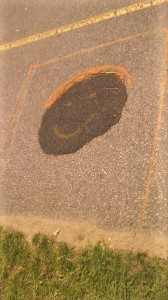
Going through old posts, I found a picture to give us a boost today.
Happy face pothole
It is the time of year for potholes in Ottawa, Canada where I live. The ground is thawing and contracting after expanding through the frozen winter. Road salt exacerbates the damage to the asphalt that crumbles under the wheels of cars.
On this pothole, patched by black asphalt, a happy person painted an orange happy face.
When life sends you potholes, put on a happy face.
Don’t get set into one form: adapt it and build your own, and let it grow. Be like water. Empty your mind. Be formless, shapeless—like water. Now you put water in a cup, it becomes the cup; you put water into a bottle it becomes the bottle; you put it in a teapot it becomes the teapot. Now water can flow or it can crash. Be water, my friend.
Over the past year, during my work at the library or as a writer, I’ve heard comments like this:
I’m trying to read now that I have more time, but I can’t concentrate!
My mind doesn’t want to focus on anything “heavy.” My productivity has plummeted.
I’m supposed to be working/writing, but it’s so difficult to stick with it.
The stresses of COVID are messing with our minds, and our productivity.
Today I wanted to lie on my couch and do nothing. That sounded like the BEST plan.
I opened my phone. I clicked on an old link. I found Bruce Lee’s phrase, and I got up off the couch.
“Imagine throwing a pebble into a still pond. How does the water respond? The answer is, totally appropriately to the force and mass of the input, then it returns to calm. It doesn’t overreact or underreact.”





 Somerton Smith