When we run a race, do we start at the finish line?
Of course not. We begin at the starting line, run every step (maybe walk a few), and cover all the ground in between.
Why do we want to start at the finish line in other areas of our lives? And why do we expect other people to be standing at the finish line before they have run the race?
Parents do this all the time. Children pass through difficult phase after difficult phase, with parents wishing each phase away:
“When will this baby ever (take a bottle . . . sleep through the night . . . wean from the breast . . .)?”
“When will my toddler ever (potty train . . . stop throwing temper tantrums . . . give up the soother . . .)?”
“When will my child ever (stop crying every day at school . . . learn to read . . . stop sucking her thumb . . .)?”
“When will my teenager ever (do his homework on time . . . clean up that pigsty of a room . . . stop doing drugs . . .)?”
We want our children to be perfect, fully formed people without letting them run the race.
We adults have unrealistic expectations of ourselves too. We want to be in some other better place instead of where we are.
Whether it’s losing ten pounds, playing “Moonlight Sonata” on the piano, finishing a jigsaw puzzle, or writing a book, we can’t start at the finish line. We have to run the race, go through the process.
I’m thinking about this on Groundhog Day.
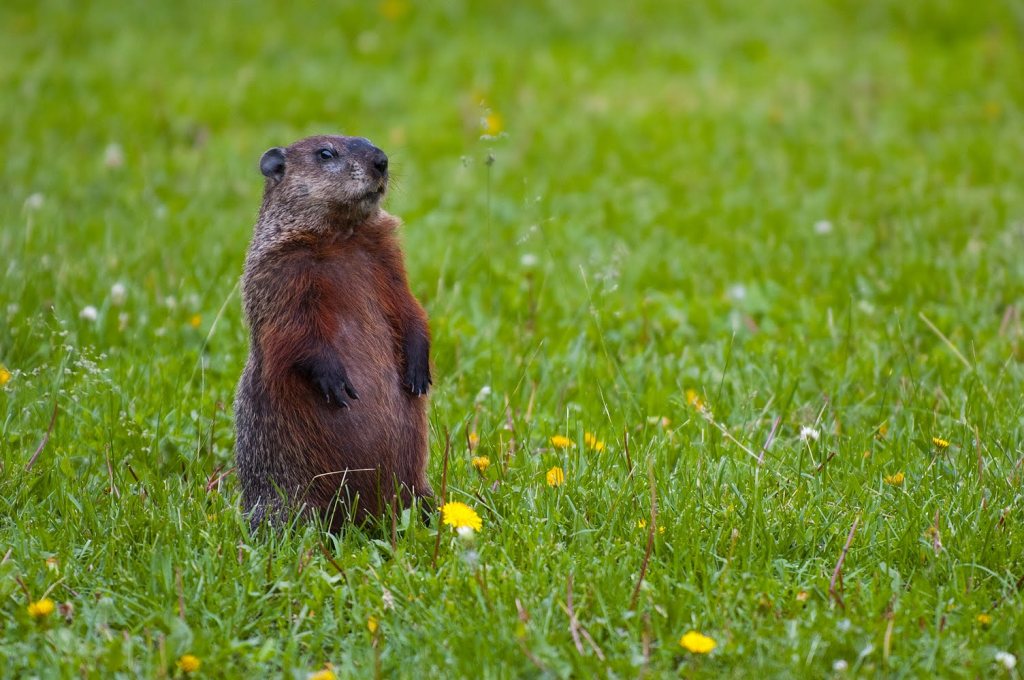
This is a picture of a groundhog in summer – not in winter in Ottawa, Canada, where I live.
No respectable groundhog is showing his face around here any time soon.
I LOVE the movie (it might be my favourite of all time), but the day? What a ridiculous idea. We can’t skip over winter to get to spring. WE ARE GOING TO HAVE SIX MORE WEEKS OF WINTER NO MATTER WHAT! This is Canada, for goodness sake. Nature has to run the race.
We can’t start at finish line. That’s the theme of the movie. Settle in. Take steps over and over. You’ll get there.
All the groundhogs in this field are snoozing under the snow.
Many people choose a word for the year. For the past few years my word has been chosen for me on the first Sunday of the year at our church. For the past nine months our “church” has not been a building; it has been an online community. The friendships with people from that community have kept me strong, led me to think, and made me laugh through the pandemic.
I guess it’s only fitting then that the word that community gifted to me for 2021 is FRIENDSHIP.
Friendship is a foundation. With a solid base of friendships, a person can hold steady through stormy times.
Friendship involves a mix of generations, of old and young sharing time.
Friendships reveal truths and provide opportunities for growth. Real friends tell us when we’re messing up. They let us know if we have grown stagnant and need to take on a new challenge.
Friendships make the world a better place. Friends volunteer together, raise funds, and help others.
Friendships promote lifelong learning. In book clubs, writing circles, courses, and one travels together, friends learn something new every day.
Friendships are fun. With friends we sing, dance, tell stories and laugh.
Friendships are comfort. They are organized compassion.
With FRIENDSHIP as my word, 2021 should be a spirit-filled year.
I am an optimist. I CAN’T HELP IT. When unfortunate events occur, my natural response is: “Okay, let’s deal with this. How can good come of it?”
This past week I was alarmed and disturbed when someone brought the phrase “toxic positivity” to my attention. The Psychology Group calls it “the dark side of the ‘positive vibes’ trend.”
We define toxic positivity as the excessive and ineffective overgeneralization of a happy, optimistic state across all situations. The process of toxic positivity results in the denial, minimization, and invalidation of the authentic human emotional experience.
— The Psychology Group: “Toxic Positivity: The Dark Side of Positive Vibes”
Has my relentless positivity been annoying the heck out of people? Have I been robbing people of their sorrow? Maybe I have friends who are secretly licking wounds I unintentionally inflicted on them?
If so, I apologize, but I CAN’T HELP IT.
It’s not that I don’t ever feel sad, or disturbed, or angry. I do. But I am incapable of dwelling in those states, and I find it hard to understand it when people do.
If there was ever a time for people to explore the breadth of emotions, it’s during a pandemic. Over the past seven months I have felt sad, disturbed and angry. Of course I have. But I’ve also been saying, “Okay, let’s deal with this. How can good come of it?”
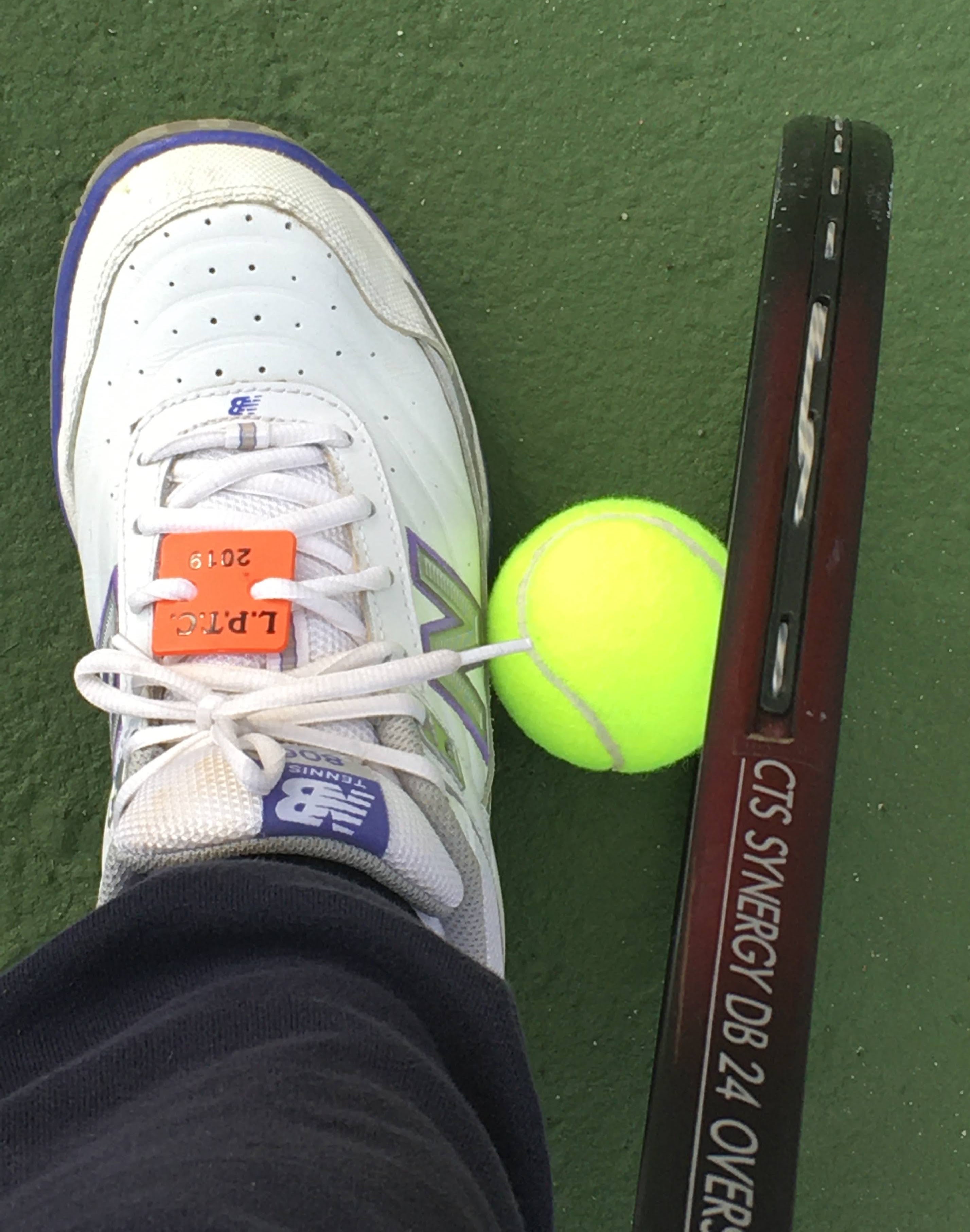
I have been practising gratitude at every turn, and I have found so many things to feel positive about. For example, I am grateful to have acquired the skill of picking up a tennis ball without using my hands, so as to (ahem) not touch other people’s balls.
No more bending! I can now lodge the ball between my shoe and the racquet and lift.
When I asked my Facebook friends, they too had found many positives amongst the negatives.
Physical Activity: My friends took up physical activities they had never done before, or had not done in a long time: tennis, biking, walking, and stand-up paddleboarding. One friend described her new kickboxing habit as a “great way to work out the COVID angst.”
Technology: We have learned how to use online communications platforms. We are doing online coaching, yoga and fitness classes. One friend learned how to use a coverstitch sewing machine to make athletic leggings with a professional look. And, of course, there’s online grocery shopping.
Connections: We aren’t seeing people like we were before, but we’re seeing people in a different way. One women meets a 94-year-old friend from Scotland every week via Zoom. Many people have met neighbours they never knew before, because suddenly everyone is working from home and going for walks. We’re helping each other with groceries and dropping off baked goods. We’re enjoying family time. playing games, eating together. While stocking up on books before the lockdown, a friend met someone who runs a writers group.
Services: Two of my friends learned how to groom their dogs. Many, many of them cut their own hair or a family member’s hair. We watched YouTube videos to learn how to do just about anything. Another friend has learned how to do her own gel nails.
Hobbies: Sewing, cooking new things, gardening, drying seeds, and canning are on the list of hobbies developed in the past seven months. I’ve been doing lots of writing. One friend started buying and selling used vinyl (albums in my lingo). He is, “having a blast. Meeting all kinds of interesting people (at a distance) and adding considerably to [his] music knowledge base.”
Self-care: Through all of this we have been trying to take care of ourselves. The physical activity is helping with that. One friend lost 30 pounds. Another friend has taken up a meditation practice.
These are all little ways of dealing with the negative. When can do them when we’re sad, mad or angry.
Collectively we’re saying, “Okay, let’s deal with this. What good can come of it?”
Put on a happy face . . . but only when you’re ready.
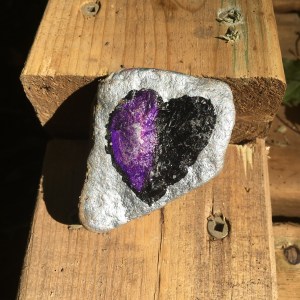
While hiking at the Mill of Kintail last week, I came across this heart rock on one of the boardwalks.
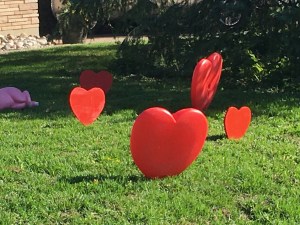
A few weeks ago, I woke up and looked out my bedroom window to see this collection of hearts on my neighbours’ lawn, in celebration of their 60th wedding anniversary.
Over the years, I’ve encountered heart-shaped rocks in several locations, including during a Habitat for Humanity build in Bolivia. That heart became part of the foundation of the house we built together.
Lake Huron rock
Habitat for Humanity rock
My niece went to an amethyst mine near Thunder Bay and brought me back this sample.
When I come across an unexpected heart, it always makes my smile. I think we all need a little lift these days, am I right?
May my found hearts help to lift yours. What are your favourite hearts?




 Somerton Smith