Author Archives: Arlene Somerton Smith

Unknown's avatar

About Arlene Somerton Smith

Plain and simple writing on meaningful topics.

What you might learn on a silent walk

I spent the past weekend at the Centre de Vie in Ripon, QC at a yoga retreat led by Andrea from Body and Balance. While there, we went for a walk on the large farm property. Andrea encouraged us to walk in silence, and then to journal about what we noticed. Here’s what I pondered as I walked on a November day in Canada.


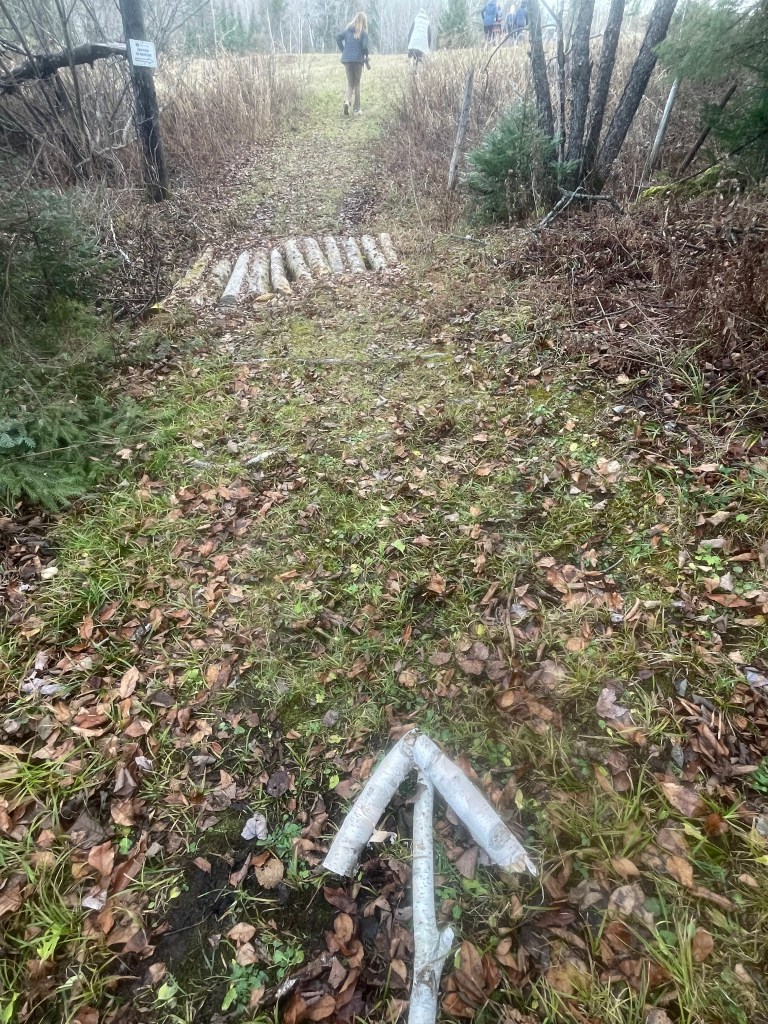
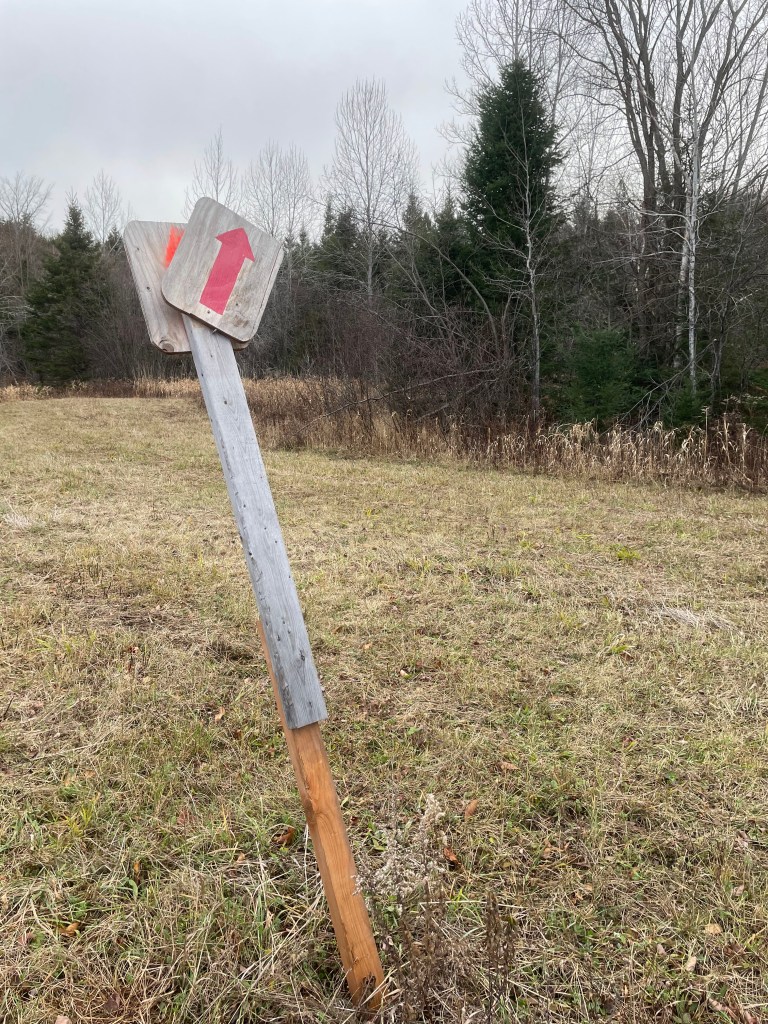
Don’t ever believe that your life is aimless. Look for signs to point you on your way. You will find them. When you see them you will worry, because you don’t know where the sign is pointing to or what lies ahead. All you might see are obstacles and uphill climbs. Keep walking anyway.
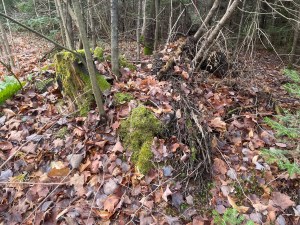
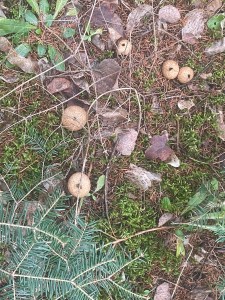
The mosses and and puffballs that aid with decomposition, and the brown composting leaves might lead you think of death and dying, but they are preparation for rebirth. The time of “wintering” is a necessary dormancy that will recharge you, and evolve you, and take you to the next stage of your life.
After you have skirted or surmounted obstacles, and after you have climbed the hills, you will descend. You think this is going to be the easy part. But going down is just as challenging as climbing up. You must take care on sharp drops and slippery slopes.
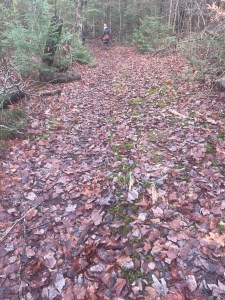
A leaf-covered forest path sloping downwards.

Soon you may realize that you have circled back to the crossroads where you started, but you aren’t the same person you were the last time you were there. You are stronger for having climbed, you are more experienced for having learned, you are more confident and prepared to take on other challenges. You climbed, you navigated, you descended, and it was good.
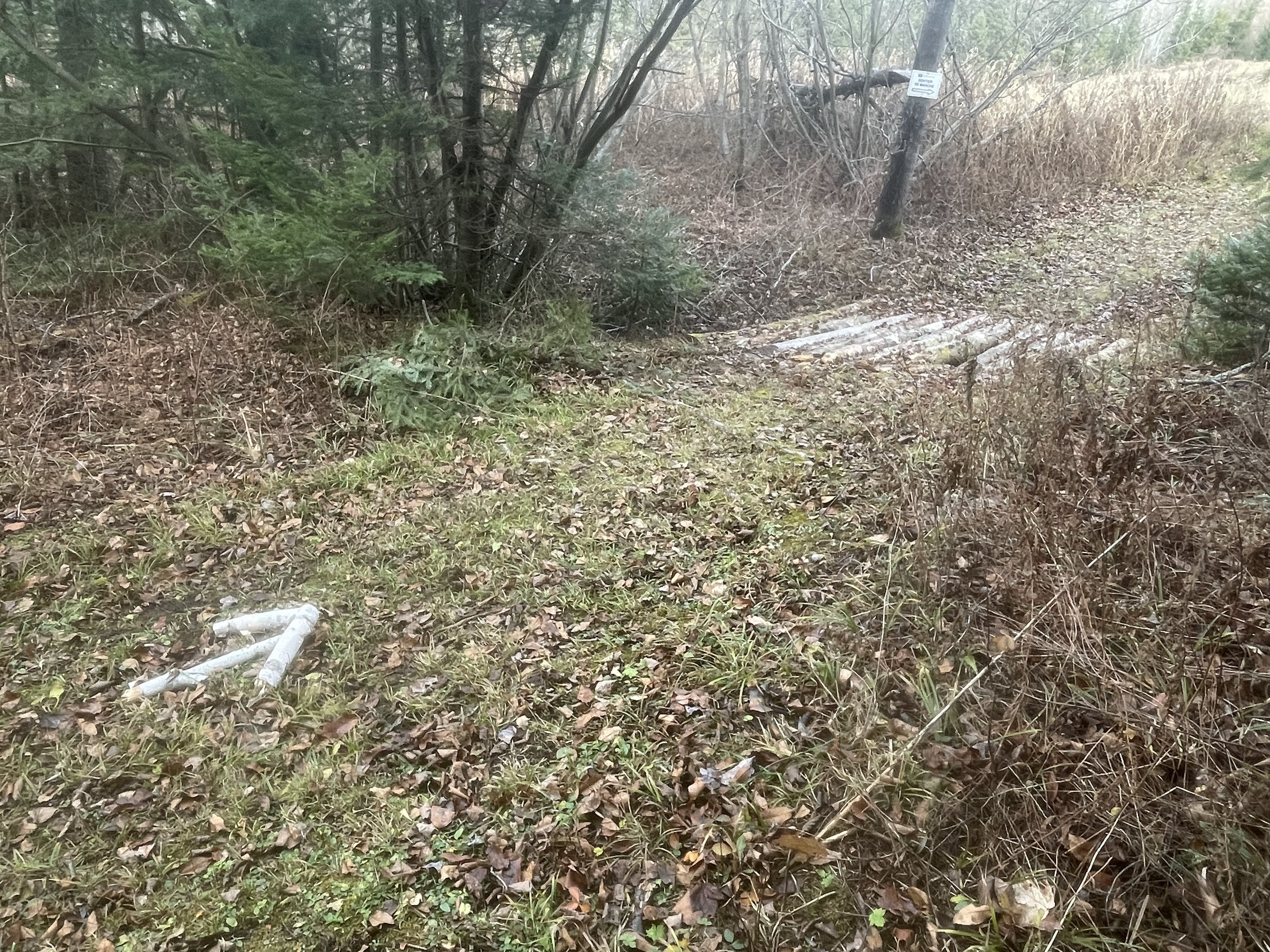
The same birch arrow and bridge, from a different angle.

Then you wander past an old piece of farm machinery, and it sparks memories of a childhood on a farm, a time and place that was both carefree and fraught with uncertainty. You’ll recall your hands in dirt and romps in fields of crops grown to feed the family. You’ll reminisce about the times that crops grew for months, tall and healthy in the sunshine, only to be struck down minutes by a violent storm. Income lost in an afternoon. You’ll remember pet calves, cherished and bottle-fed that became ill and died from disease. It was more than the tragic loss of loved animals. It was an economic blow. But your family grew other food, so you didn’t go hungry, you lived in an old farmhouse, so you were never out in the cold, and you had family.
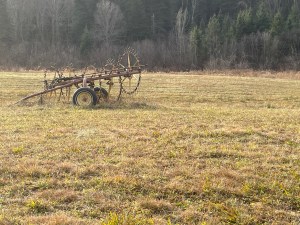
Old farm machinery in the middle of a field of shorn hay.

As you walk silently back to a different farmhouse in a different time, you’ll recall that money isn’t what’s most important. Food, shelter and community are all that really matters.
The moving finger writes: Letting go

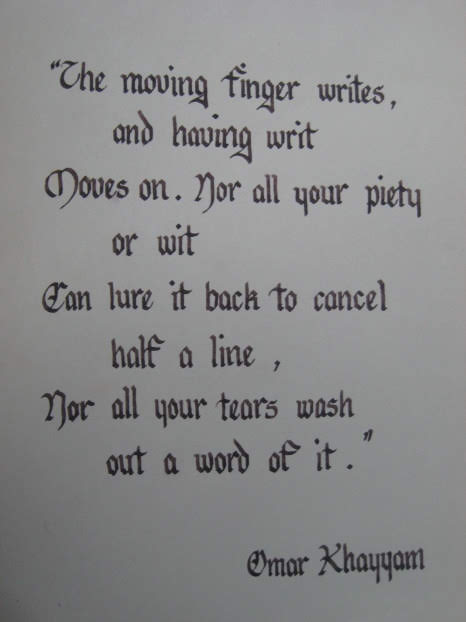
The moving finger writes,
and having writ
Moves on. Nor all your piety
    or wit
Can lure it back to cancel
    half a line,
Nor all your tears wash
    out a word of it.
—Omar Khayyam

I kept a copy of this poem on my university dorm room wall. The words helped me to let go of things that needed letting go—bad grades, big mistakes, over-indulgences.

Now I’m an older, and my moving finger has written a lot of lines.

Most I wouldn’t choose to cancel. I want to cling to memories of the fresh way my children smelled when they came in from playing in the rain, the sound of my son’s toddler laugh, and the way the sun lit up my daughter’s blond hair when she ran across the park behind our house. I want to stop time and cling to all those joyful things. But I have to let go. The moving finger insists upon it.

Everyone who knows me well knows that I idolize Roger Federer, a retired professional tennis player. He owes his success to his outstanding skill AND his ability to let go. We could never count Federer out of a match. If he missed a shot, he didn’t dwell on the mistake. He learned from it, let it go and moved on to success.

We like to cling to things, don’t we?

We cling to cherished possessions. That’s fine, unless our house begins to look like an episode of Hoarders. We cling to our children. That’s fine, unless we smother them and prevent them from learning to manage their own lives. We cling to our mistakes. That’s fine, unless we get mired in believing that a mistake defines us.

Letting go is an acquired, and necessary, skill.

I foster it every time I receive a rejection to something I’ve written. If I let go of enough resentments, doubts or regrets, I open up room for other, better opportunities.

Moving on . . .

The cycle of writing, she exclaimed!

said-bookism (plural said-bookisms) – Noun
1. The studious avoidance, in writing dialogue, of the word “said”.
Synonym: bookism
https://en.wiktionary.org/wiki/said-bookism

    Experts said: Don’t drown your dialogue in attributions like exclaimed, whispered, demanded, asserted, murmured, shouted, whimpered, inquired, queried or, heaven forbid, spat. [The experts pleaded, prompted, advised, demanded, urged . . .]

    I agreed with that advice.

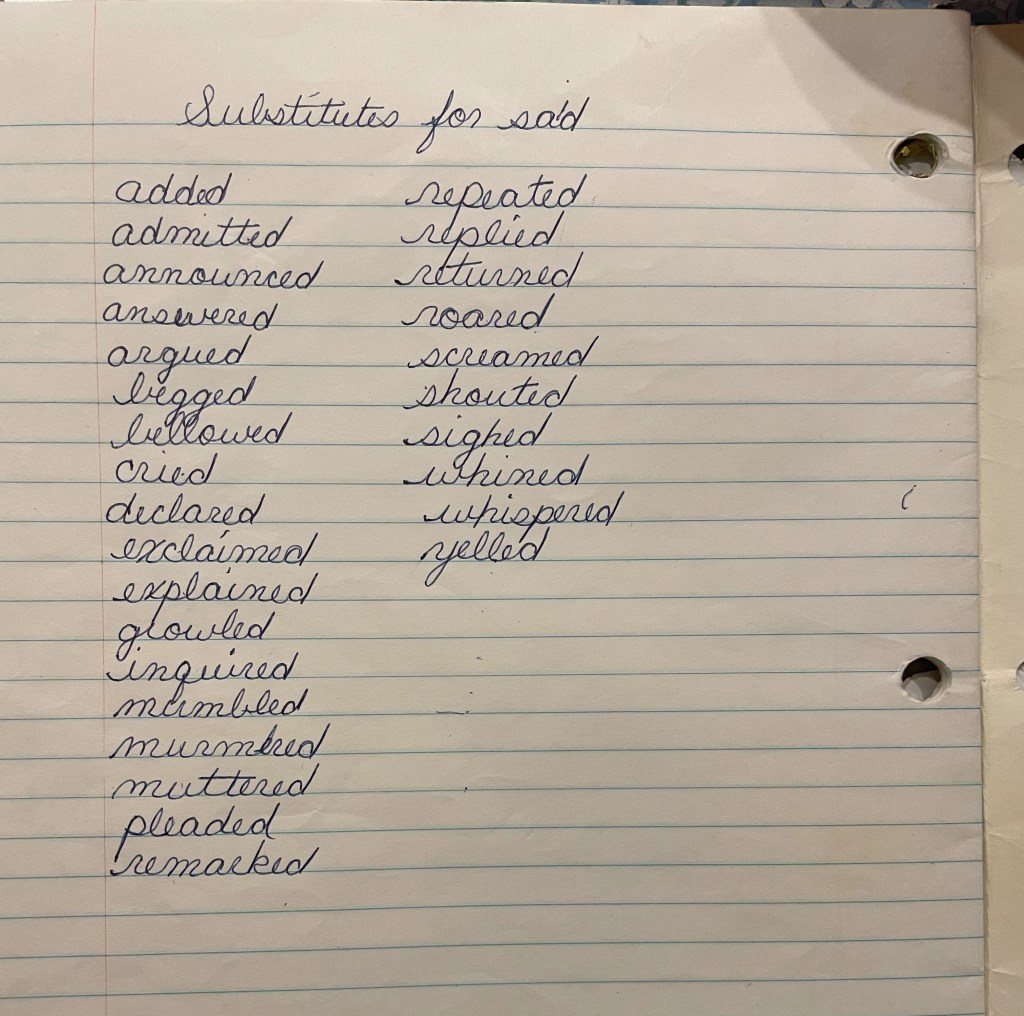
    But then, I began a clutter clean-up in my basement, and I happened upon a notebook from my Grade 8 English class. On the last page, I found this: a list of words to use instead of said. Way back in the 1970s my teacher advised me to liven up the story. Avoid using said, they said (proposed, urged argued . . ..

    Old notebook with list of Subtitutes for Said: added, admitted, announced, answered, argued, begged, bellowed, cried, declared, exclaimed, inquired, mumbled, muttered, etc.

    The pendulum swung toward repeated, roared, whined, yelled, remarked, declared, bellowed, argued, announced . . .

    Good heavens, but that became tiresome, if not outright ridiculous. So the pendulum swung back to said.

    And now, the pendulum swings again. As readers we find we don’t mind an occasional declaration. If a character roars now and then, it’s okay!

    What do you think? Do you enjoy writing enlivened by interesting attributions, or do you prefer our good old standby said?

    Don’t rush, shop around, work in phases, have faith

    Broadview magazine included an article I wrote about my church’s transition from an old boiler heating system (and no air conditioning) to heat pumps for both heating and cooling.

    The article includes four subheadings: Don’t rush, shop around, work in phases, and have faith.

    Those same four subheadings apply to more than heat pumps, right? Writers on their journeys, families navigating life challenges, and people facing health problems can all benefit from a similar approach.

    Whatever life throws at you today, don’t rush, shop around, work in phases, and have faith.

    New shoulders, new roads

    In Canada we joke that we have two seasons: winter and construction.

    From when the snow melts in spring until it builds up in mounds again the following winter, barriers and pylons obstruct streets and roads.

    Three large road construction vehicles line up behind a orange barrier. A sign on the barrier reads, "Danger due to construction."
    Danger due to construction

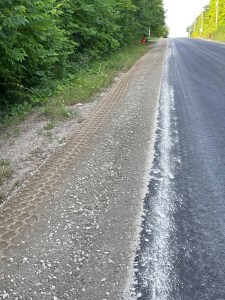
    This summer my home lay at the heart of a vortex of road improvements. Crews tore up ditches in one direction to make room for bicycle lanes. Workers in another direction stripped old asphalt, shored up the shoulders with thick gravel, and laid down a fresh layer of pavement.

    View up the hill of a country road with new gravel shoulders and fresh pavement. Construction pylons frame the road at the top of the hill.

    While construction was underway, the posted signs read, “Danger due to construction.” Now I walk along this road, with its strong shoulders and new pavement—construction danger in the past.

    The unblemished brightness of it symbolizes to me the fresh start of autumn. As road construction slows down in our northern climate, we begin different kinds of construction. New school projects, new organizational meetings, new roads to new adventures.

    I wonder what I’ll build this winter? What dangers will I face? I can’t wait to find out.

    What are you constructing these days?

    Still learning after all these years

    This morning on my morning walk with a friend, we watched a fox scramble up a gate and scamper along the top of a fence like a squirrel. (Very much like in the third photo below.)

    I grew up on a farm. I’ve lived a long time. How did I not know that foxes could do that?

    I love that life offers surprising gifts of learning every day, no matter how old a person gets.