Category Archives: Author

Bless that which you want

According to the ancient Polynesian wisdom of Ka Huna, we should bless that which we want.

The shamans of Hawaii use the power of words and mind to heal the self, others and situations. They believe:

  • If we resent people who have what we want, our resentment keeps what we desire away. (Don’t you want to avoid resentful people?)
  • If we believe ourselves unworthy of receiving, that drives away the object of our desire. (Wouldn’t you rather hang around with confident friends?)

Resentment and feelings of unworthiness are both negative emotions. When we bless, there’s no room for negativity. Blessing nuzzles it out of the way.

Blessing has no space for thoughts like:

  • “Oh sure, why does he get to live in a big house when I’m stuck in a tiny apartment.”
  • “Those shoes would look so much better on me.”
  • “I don’t want to be a multi-millionaire. I don’t want to have to worry about handling all that money.”

When we bless others, their day gets a little brighter, and we feel better too. The positives grow in an ever-expanding ripple.

What do you want to bless today? 

Writing life

Another re-post during my mini-vacation. I spent last week participating in the Humber School for Writers Summer Workshop. The writers in my group agreed: Writing is a tough slog. But then, so is life in general! I might as well spend some of it writing and occasionally stumbling into moments of bliss.


At a gathering of our local branch of the Canadian Authors Association, we writers shared words to describe the writing experience.

Words for writing and life

Terror, right above Bliss. 

Mystical right in the middle of everything.

Fun not far away.

Elusive, more than once.

Tranquility and Solace.

Hard work, Glass Wall, Escape.

Mindblowing, Universal, Wonder. 

Our word cloud described the writing experience, and life in general.

Odd but beautiful

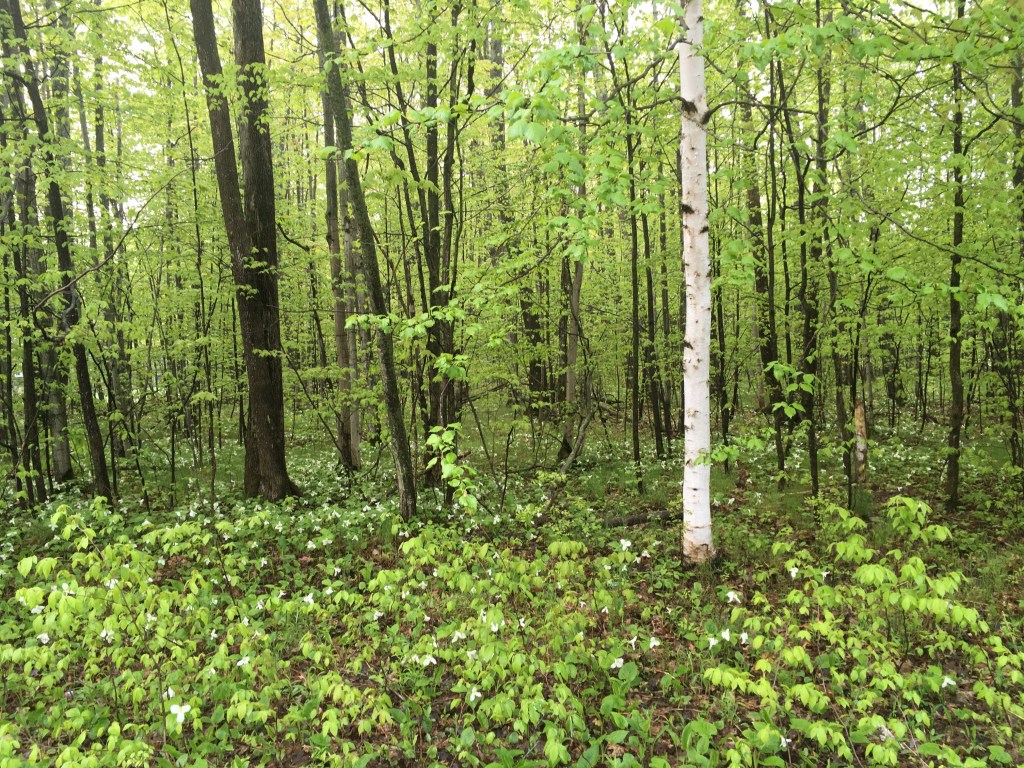
One white birch tree in a green forest, trilliums in bloom around it.

A lone birch amongst other deciduous trees, hundreds of trilliums at its feet.  

To me, the picture represents . . .

. . . determination to be authentic no matter what is going on around . . .

. . . a white tree being applauded by an audience of trilliums . . .

. . . alone, but not lonely. . .

What does the picture bring to your mind?

3 important answers

Book cover for Jon J. Muth's The Three Questions

It’s time once again to remember The Three Questions by Jon J. Muth.

Muth took a short story written by Leo Tolstoy and reworked it with animal characters to appeal to children. In the book, a boy named Nikolai goes on a journey to seek answers to three BIG LIFE questions:

  1. “When is the best time to do things?”
  2. “Who is the most important one?”
  3. “What is the right thing to do?”

His steps lead him to encounters with a heron, a monkey and a dog. Each of these characters answers the questions in way that reflects personal biases. The heron suggests the best time to do things is after everything has been planned in advance. The dog believes the most important one is the one who makes the rules, and the monkey knows the right thing to do is to have fun all the time.

Not satisfied, Nikolai climbs a high mountain to seek the answers to his questions from a wise old turtle.

When he reaches the top of the mountain, he finds the wise, old turtle digging a garden. Wanting his full attention and knowing that a young boy digs much faster than an old turtle, Nikolai takes the shovel and finishes turning over the hard soil.

When he is leaning on his shovel after the last shovel full of dirt, he hears a cry for help coming to him out of the windblown forest. He follows the sound and finds a panda knocked out by a fallen tree. Nikolai rescues her and takes her to the turtle’s house to get warm.

When the panda wakes up, she asks, “Where is my child?” Alarmed, Nikolai runs back to the forest where he finds the baby panda, shivering and alone.

Before Nikolai departs, he and the wise old turtle reflect on the answers the boy has found.

  1. “There is only one important time, and that time is now.”
  2. “The most important one is always the one you are with.”
  3. “The most important thing is to do good for the one who is standing at your side.”

Tolstoy sure was one wise old turtle.

Embracing interruptions

I’m away on a short vacation – interrupting my routine. While I’m travelling, I’m re-posting some old posts from my previous blog site. Enjoy.

One of the joyous frustrations of freelance writing is its unpredictable variety.

Notebook with blank pages.

I never know if I’ll be writing about money, or toilet installation, or chickens, or veterans, or crows, or . . . the list goes on. I never know when I’ll receive the last-minute phone calls. I get up in the morning with plans to do something and then, BAM, the phone rings. My whole day gets knocked sideways.

The frustration happened yesterday. The phone call came and all the things I’d planned to do and write about got swept off my calendar. It’s difficult to make firm plans. And if you ever drop by my house and see dust on the furniture, you know why.

The joy comes from learning about new things all the time. I am so lucky to never feel like I’m in a rut. I get paid to write! How great is that? 

Another joyous benefit of my freelance writing career is the reading I do on many topics. Years ago, one of those reading stints led to me this best piece of advice:

Embrace interruptions.

When I’m writing, I focus. I dive deep down into a well of creative thought and if someone speaks to me I need to swim my mind up through sludge to the surface again. I can practically hear the murky bubbles around me.

Interruptions used to drive me bonkers.

Now I tell myself: There is a purpose behind this interruption. How does it benefit me?

It gives me a chance to get a drink or go to the bathroom. It makes me notice the typo I overlooked before, once I settle back into place and look with refreshed eyes at the work I’ve done. It gives me an extra 24 hours to write a blog post.

Interruptions come in big and small sizes too.

There’s the simple, “Mom, are we out of milk?” kind of interruption, and then there’s the, “You need to take this. I’m afraid there’s bad news,” kind of phone call that knocks a life sideways for weeks, or months, or years. The big ones are harder to embrace, but perhaps it’s even more important to look for the gifts in those doozies.

There is a purpose behind your interruptions. How do they benefit you?

So THAT’S what happens: Being at peace with life

Sometimes it’s difficult to find peace when nasty surprises upset our lives. Sometimes it’s even a challenge to savour fun events or exciting bonuses.

We waste time evaluating whether something is “good” or “bad.” We forget to head straight to accepting what is.

And appearances can be deceiving. Events that appear catastrophic at first can lead to unforeseen good fortune. Other occurrences that strike us as boundless good luck turn out to be the opposite.

All of us would love to have 100 percent control over what happens in our lives. But we don’t. Unplanned events inevitably derail our plans.

When that happens to me, I try to remember to rise above it and survey everything as an impartial observer. I try to view whatever comes—no matter what it is—as a big, welcome surprise.

“So THAT’s what happens!”

Stuck in the slow line at the grocery store? So THAT’S what happens! A winning goal for your hockey team in overtime? So THAT’S what happens! You’re fired? So THAT’S what happens!”

It’s easier to be at peace with unforeseen twists of fate — illnesses, riches, petty disagreements, journeys, friends, deaths or births — if all of them, no matter what , are viewed as big, welcome surprises.

So THAT’s what happens! Surprise!

I wonder what happens next?

An arrow pointing to the right with the word Next on it