Category Archives: Lifestyle

What you might learn on a silent walk

I spent the past weekend at the Centre de Vie in Ripon, QC at a yoga retreat led by Andrea from Body and Balance. While there, we went for a walk on the large farm property. Andrea encouraged us to walk in silence, and then to journal about what we noticed. Here’s what I pondered as I walked on a November day in Canada.


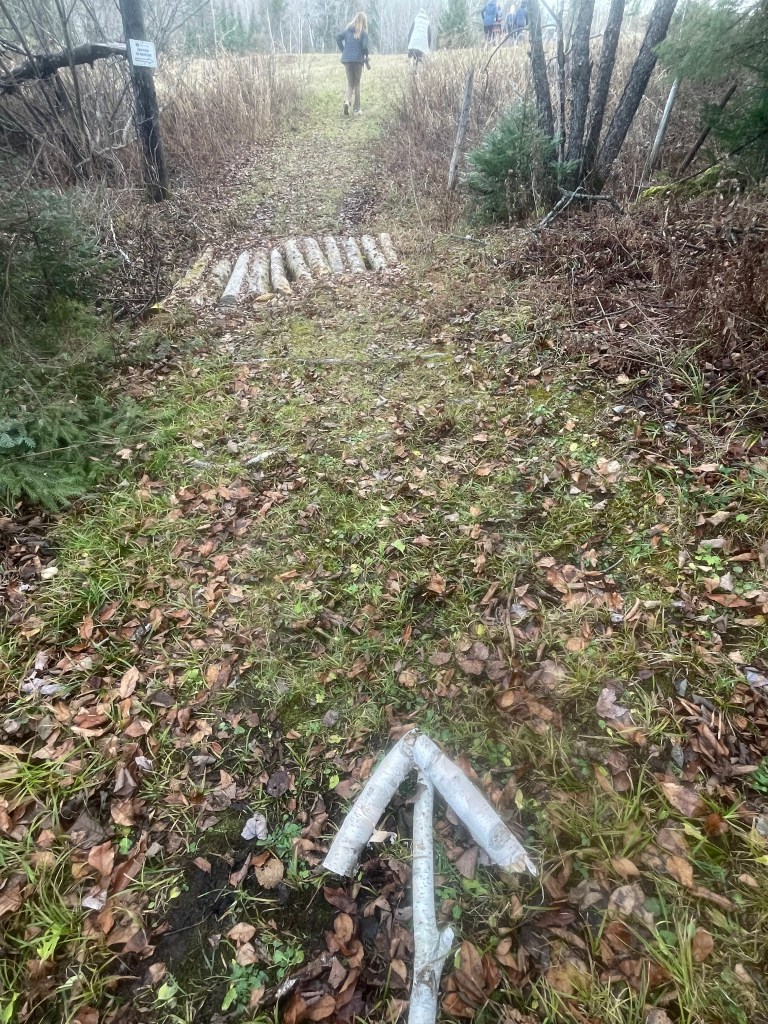
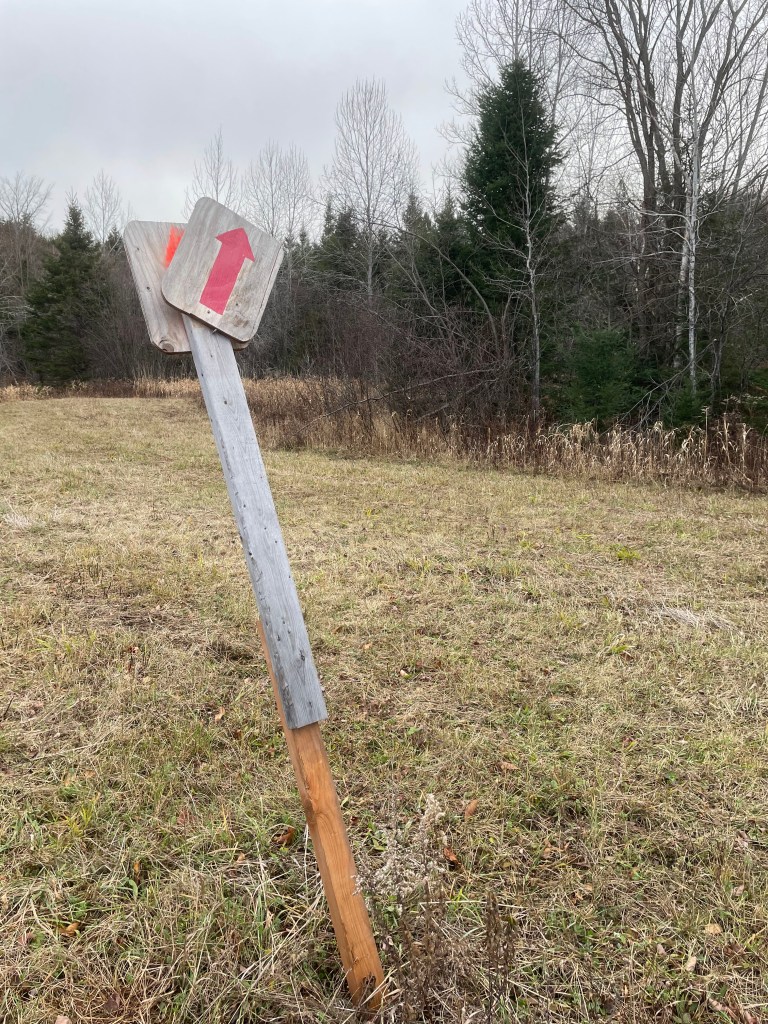
Don’t ever believe that your life is aimless. Look for signs to point you on your way. You will find them. When you see them you will worry, because you don’t know where the sign is pointing to or what lies ahead. All you might see are obstacles and uphill climbs. Keep walking anyway.
The mosses and and puffballs that aid with decomposition, and the brown composting leaves might lead you think of death and dying, but they are preparation for rebirth. The time of “wintering” is a necessary dormancy that will recharge you, and evolve you, and take you to the next stage of your life.
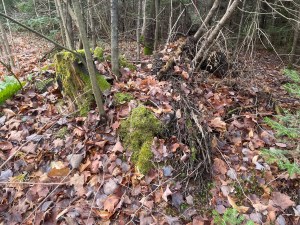
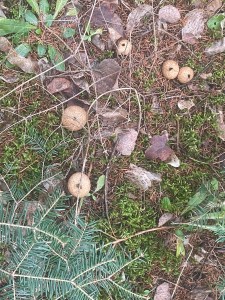
After you have skirted or surmounted obstacles, and after you have climbed the hills, you will descend. You think this is going to be the easy part. But going down is just as challenging as climbing up. You must take care on sharp drops and slippery slopes.
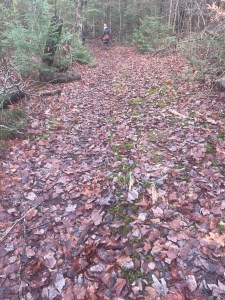
A leaf-covered forest path sloping downwards.

Soon you may realize that you have circled back to the crossroads where you started, but you aren’t the same person you were the last time you were there. You are stronger for having climbed, you are more experienced for having learned, you are more confident and prepared to take on other challenges. You climbed, you navigated, you descended, and it was good.
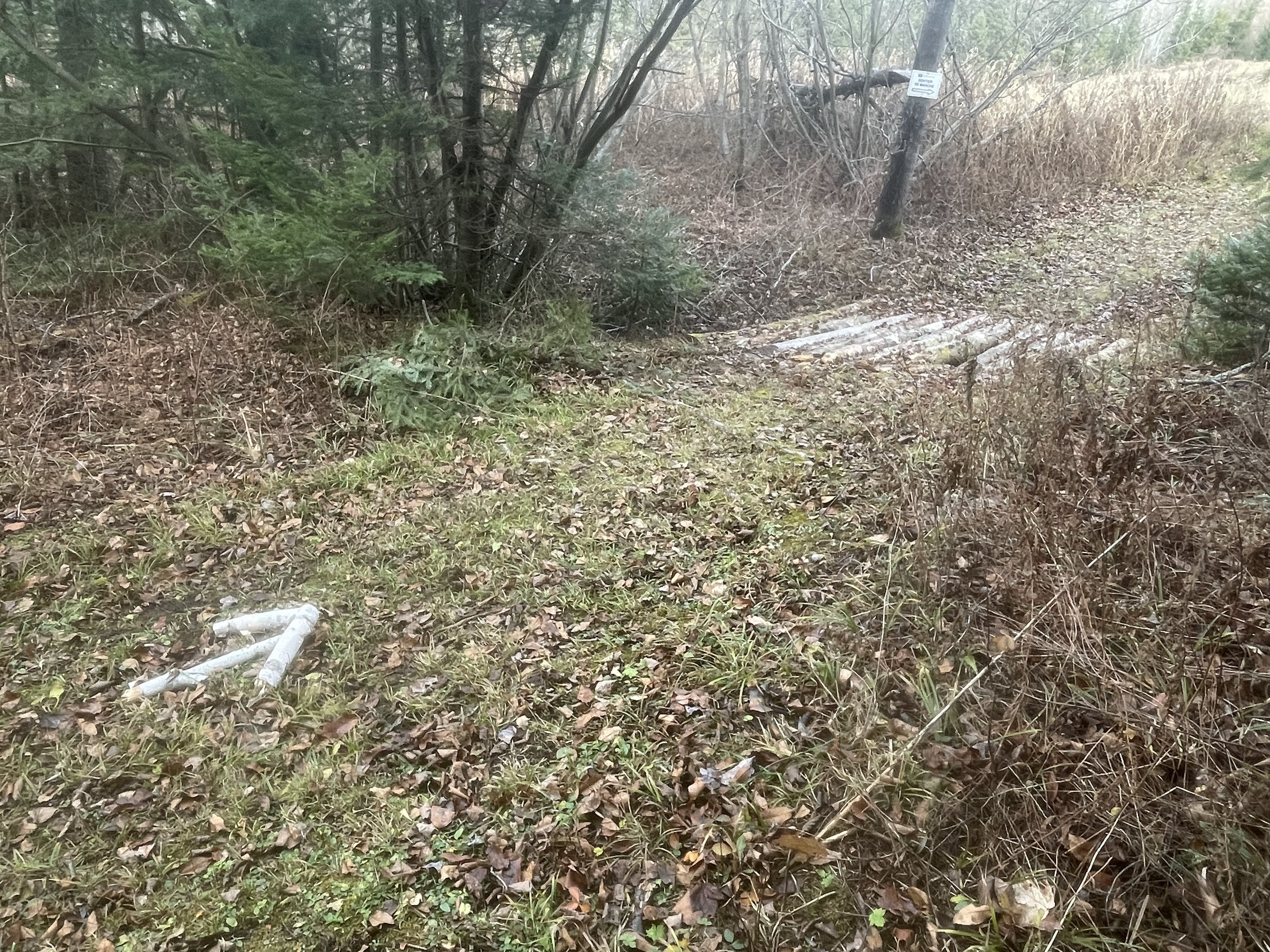
The same birch arrow and bridge, from a different angle.

Then you wander past an old piece of farm machinery, and it sparks memories of a childhood on a farm, a time and place that was both carefree and fraught with uncertainty. You’ll recall your hands in dirt and romps in fields of crops grown to feed the family. You’ll reminisce about the times that crops grew for months, tall and healthy in the sunshine, only to be struck down minutes by a violent storm. Income lost in an afternoon. You’ll remember pet calves, cherished and bottle-fed that became ill and died from disease. It was more than the tragic loss of loved animals. It was an economic blow. But your family grew other food, so you didn’t go hungry, you lived in an old farmhouse, so you were never out in the cold, and you had family.
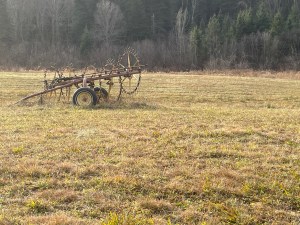
Old farm machinery in the middle of a field of shorn hay.

As you walk silently back to a different farmhouse in a different time, you’ll recall that money isn’t what’s most important. Food, shelter and community are all that really matters.

Don’t rush, shop around, work in phases, have faith

Broadview magazine included an article I wrote about my church’s transition from an old boiler heating system (and no air conditioning) to heat pumps for both heating and cooling.

The article includes four subheadings: Don’t rush, shop around, work in phases, and have faith.

Those same four subheadings apply to more than heat pumps, right? Writers on their journeys, families navigating life challenges, and people facing health problems can all benefit from a similar approach.

Whatever life throws at you today, don’t rush, shop around, work in phases, and have faith.

New shoulders, new roads

In Canada we joke that we have two seasons: winter and construction.

From when the snow melts in spring until it builds up in mounds again the following winter, barriers and pylons obstruct streets and roads.

Three large road construction vehicles line up behind a orange barrier. A sign on the barrier reads, "Danger due to construction."
Danger due to construction

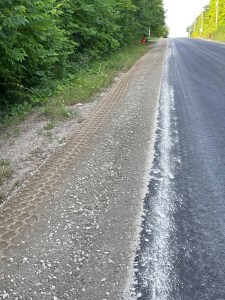
This summer my home lay at the heart of a vortex of road improvements. Crews tore up ditches in one direction to make room for bicycle lanes. Workers in another direction stripped old asphalt, shored up the shoulders with thick gravel, and laid down a fresh layer of pavement.

View up the hill of a country road with new gravel shoulders and fresh pavement. Construction pylons frame the road at the top of the hill.

While construction was underway, the posted signs read, “Danger due to construction.” Now I walk along this road, with its strong shoulders and new pavement—construction danger in the past.

The unblemished brightness of it symbolizes to me the fresh start of autumn. As road construction slows down in our northern climate, we begin different kinds of construction. New school projects, new organizational meetings, new roads to new adventures.

I wonder what I’ll build this winter? What dangers will I face? I can’t wait to find out.

What are you constructing these days?

When you start to think, stop.

“My gauge each day, in all things, is simply this: Is what I’m choosing (to think, do or say) moving me closer to my Creator or farther away? For this question, I am immensely thankful. It saves me an awful lot of backtracking, worry lines, frustration, angst and apologizing. Today and every day, I give thanks for my ability to exercise power of choice—even when I’ve chosen wrong.”

—Richard Wagamese in EMBERS: ONE OJIBWAY’S MEDITATIONS

Years ago I attended a writing workshop led by Richard Wagamese. His process, he told us, was to go for long walks in the hills and tell himself a story out loud as he climbed. When he returned home, he’d write it all down, letting the words pour unto the page. He’d write, he said, until he “started to think.”

When thoughts began to run through his head—”Is that the right word?” or “Should I take that part out?” or “This is the worst thing ever”—it was time to stop.

The words weren’t coming from Source anymore.

At the workshop he invited participants to give him a topic—any topic—so that he could tell us a story. Several times he received his subject, reflected only for a second or two, and then began to speak.

In a miraculous way, he opened himself up to become a channel for story. He surrendered to it. Story unfolded through him, complete and beautiful from beginning to end.

I think of this often, when my hands hover over laptop keys, uncertain. Or when those questions or comments start to circulate. “Does this word belong?” or “Is that part too long?” or “Am I wasting my time with this?”

I’m no Richard Wagamese, but I try to recreate what he showed to me that day, not only in writing, but in day-to-day life. For stories or for difficult decisions, I try to open, to surrender, and to allow the unfolding.

When I manage it, even a little, I’m surprised by how complete and beautiful it all turns out, from beginning to end.

And when I start to think, I stop.

Cover of Embers: One Ojibway's Meditations by Richard Wagamese

Pi Day, P.I.E. Day, Pie day

March 14, or 3/14 ,celebrates Pi, the ratio of a circle’s circumference to its diameter most often approximated with the decimal 3.14. What better way to celebrate the irrational number (a decimal with no end and no repeating pattern) than by eating pie!

This day in Canada is also P.I.E. Day, a day to be Public, Intentional and Explicit allies of LGBTQ2SIA+ people. There is no end and no repeating pattern to people. Let’s affirm that. Let’s celebrate that by eating pie!


I invite you to scroll down below the picture of the pie and read the words of my cherished friend, Derek Kitchen, a member of the Pride group at my church.


The theme for P.I.E. Day is the year of intention. In the coming year what can I learn? What steps can I take to overcome fear? I intend to find out.

Read more about why we need more P.I.E. please.

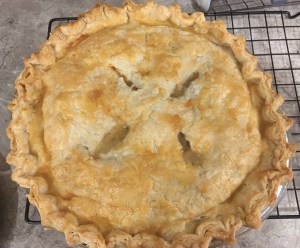
Apple pie

Why we need more P.I.E., please

By Derek Kitchen

As an affirming congregation we love our trans brothers, sisters, children, grandchildren, friends, extended and chosen family and friends.

But I would also ask that, in order to affirm trans people, we may need to better understand the challenges posed by those who fear them, and perhaps educate those who act out of fear and misunderstanding.

We are now familiar with the challenges faced by trans refugees who have been beaten, tortured, burned out of their encampments, and faced with abuse even from governments, clergy, police and other refugees.

Trans people are murdered and subjected to violence at a higher rate than other gay and lesbian people. The human rights campaign reported the highest number of murdered trans people ever in 2021 with a reported total of 58 trans people murdered, predominantly members of the Black and LatinX populations. It is further expected that many trans murders go unreported because of stigmatization and homelessness amongst the trans community.

Trans youth are at a high risk for suicide. Lesbian, gay and bisexual teens in Canada are 5 times more likely than other teens to consider suicide and 7 times more likely to consider it. Trans youth are at even greater risk. The national institute of health in the USA reports that 86% of trans youth have seriously considered suicide, and 56% have had at least one suicide attempt.

It is important for us to support all trans people, but especially to support younger trans people who are at much higher risk. We need to provide safe spaces where they can ask questions without being judged, and many cannot do this safely at home, with their doctors, in their schools or faith communities.

Lest we think this is mostly an American problem, I’ll refer you to a CBC story from March 5, exactly one week ago. Some teachers in the York Catholic District School Board, have been displaying “Safe Space Stickers” the size of bumper stickers. These feature the inclusive pride flag, with trans colors included, and they signal acceptance to LGBTQ children and teens. Many of these stickers have been torn, defaced with epithets and profanity, and removed.

Police had to be called when a group of parents stormed the board meeting to protest the use of these stickers in schools. There were comments like, “They are not safe spaces. They should warn that they’re danger zones!” and “They’re preaching confusion and acceptance which is truly disgusting.” One parent said the stickers were not compatible with faith and that LGBT students should not be allowed to attend the school.

Now we know that in Ontario this kind of exclusion is a violation of the Ministry of Education’s Human Rights policies, but this does not make the situation any less complicated for trans kids or their families.

I would suggest that we not be silent when we see this kind of oppression.

As allies to the trans community, we cannot remain neutral because remaining neutral only empowers the oppressor.

There are many ways to be an ally to trans people. There are many online and other resources that can elaborate on simple strategies explaining how you can help. Most importantly, we can try to educate those who may be acting in harmful ways, possibly out of fear.

“There is no fear in love, but perfect love casts out fear…whoever fears has not reached perfection in love.”

— 1 John 4:18

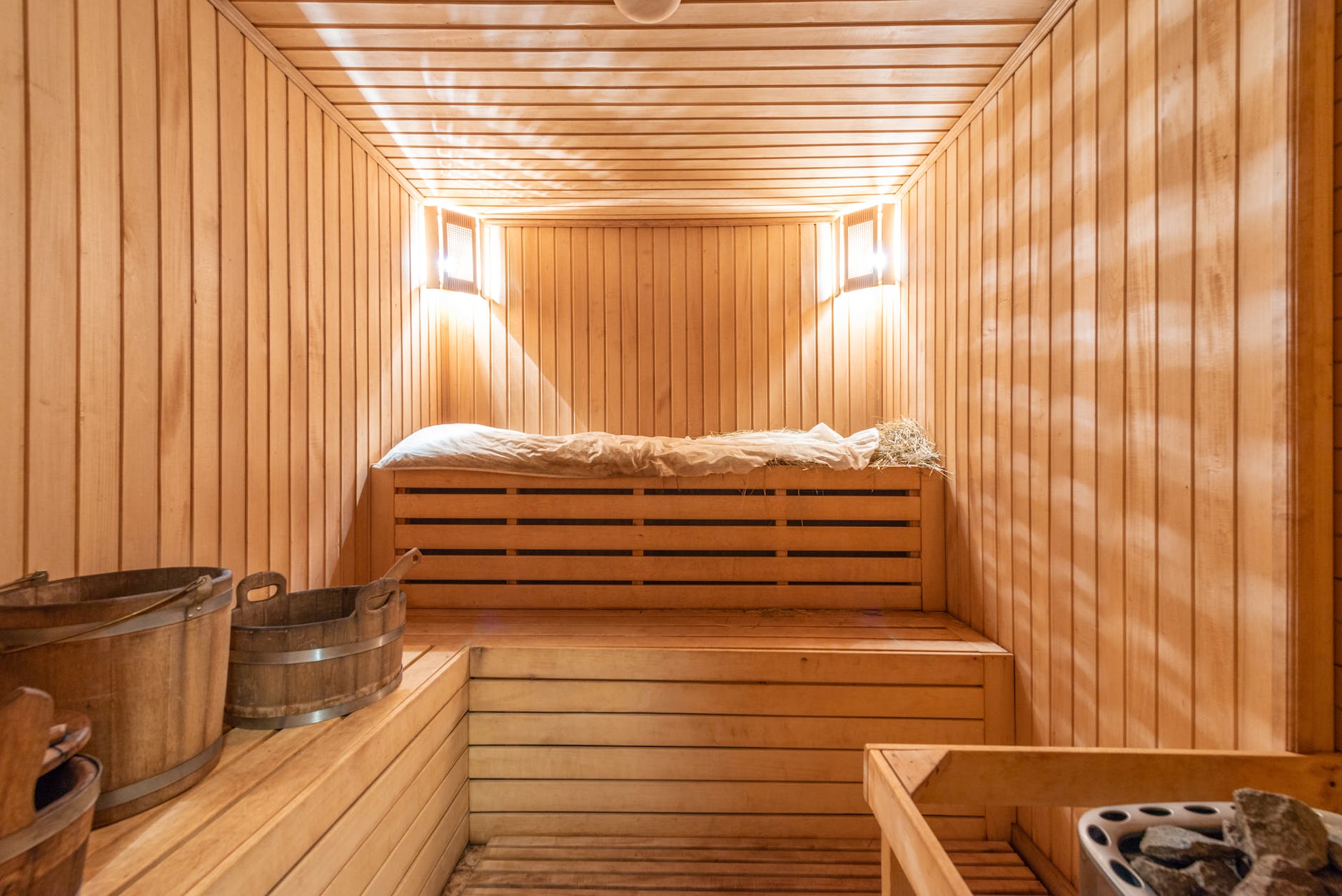
In sauna


“I noticed that she used this phrase again and again: in sauna rather than in the sauna. She’s not talking about a building, a little pine shed with burning coals in the corner; she’s talking about a state of being.”

—Katherine May, speaking of a Finnish friend in Wintering: The Power of Rest and Retreat in Difficult Times


Yesterday I took a day. A whole day.

I went for a short walk, but other than that I did nothing but lie on my couch, read a book, and watch the Toronto Blue Jays and Tim Hortons Brier curling.

I don’t have a pine shed with burning coals or a cedar-lined sanctuary, but I spent the day in sauna, in the way of Katherine May’s friend.

That is something I almost never do. I’m always doing something.

It was glorious.

Today I feel restored, and that is the power of rest and retreat.

Photo by Max Rahubovskiy on Pexels.com